


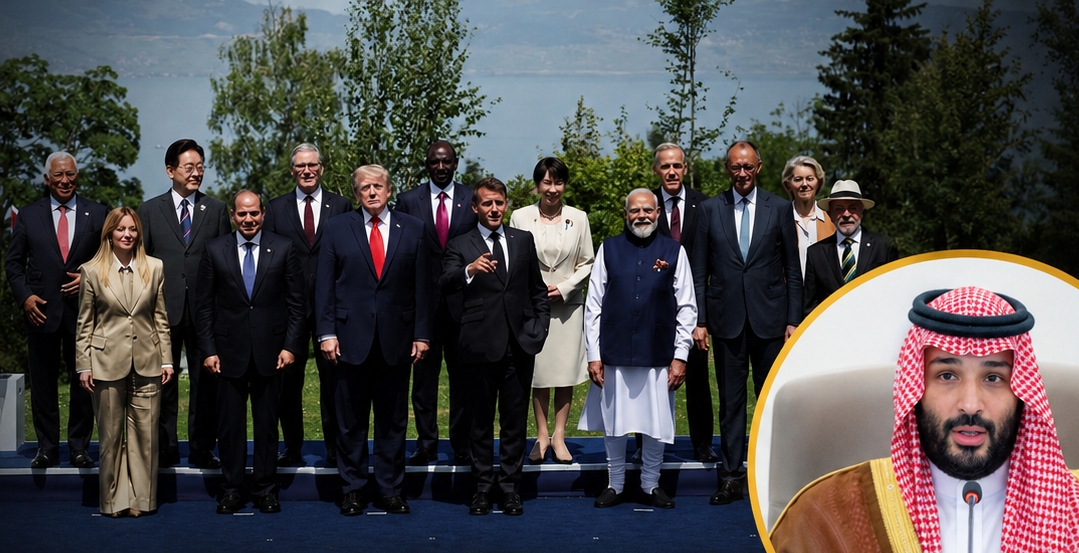
A Telegraph column argues Saudi Arabia has a stronger claim than any other candidate to join an expanded G8, citing its unmatched power broker status across the Middle East.
By Imran Malik | World Affairs Desk | MediaBites.com.pk
The debate over expanding the world’s most exclusive economic and political club has resurfaced, and this time, the strongest case being made is not for a familiar Western-aligned democracy, but for the Kingdom of Saudi Arabia.
Writing in The Daily Telegraph, commentator Ken Costa delivered a sharp critique of the G7’s current relevance, arguing the grouping has not kept pace with the realities of twenty-first century geopolitics.
An Institution Stuck in the 1970s
Costa argued that the G7 remains a small club of liberal democracies which might possibly have been the seven most significant powers in the world in the 1970s, but can no longer credibly make that claim today. The world’s centres of economic and strategic gravity have shifted dramatically since the group’s founding, yet its membership has remained almost frozen in time.
Various countries have previously been floated as candidates for inclusion in an expanded grouping, including Australia, South Korea, Spain, and Indonesia. Each carries its own credentials, developed economies, stable democratic institutions, and meaningful roles within their respective regions.
The Case for Saudi Arabia
Yet Costa makes a compelling argument that none of these candidates matches Saudi Arabia’s claim to a seat at the table. He notes that Saudi Arabia might only just make it onto a list of the world’s 20th largest economies, but argues its importance as a power broker outweighs that modest economic ranking entirely. He describes the kingdom as clearly the leader of the Middle East’s middle powers.
This is the crux of the argument. Economic size alone, by Costa’s reasoning, is an outdated metric for measuring a nation’s strategic relevance. Saudi Arabia’s influence operates on a different axis entirely, one built on its unrivalled position within OPEC, its deepening role as a regional security broker, and its growing capacity to shape outcomes in conflicts that the traditional G7 powers increasingly cannot resolve alone.
Costa further stressed that retaining a staunch ally among Arab nations is vital for the Western world, framing Saudi inclusion not as a courtesy but as a strategic necessity for any grouping that hopes to remain globally relevant.
READ MORE: Arab News Editor, Faisal J. Abbas, hails Pakistan’s ‘Golden Era’ with Saudi Arabia, calls transformation ‘Phenomenal’
A Kingdom Already at the Table, Informally
Saudi Arabia’s path toward this moment has been building steadily. Crown Prince Mohammed bin Salman has been repeatedly invited to attend G7 summits as a guest, including the most recent gathering in the Canadian Rockies, reflecting the kingdom’s growing informal integration into G7-level conversations even without formal membership status.
Saudi Arabia’s significance was further underscored by its position as a key player in regional diplomatic efforts, including hopes of brokering peace amid the broader instability gripping the Middle East. Riyadh has positioned itself not merely as an oil producer, but as an indispensable mediator in a region where Western diplomatic leverage has visibly diminished.
Why This Moment Matters
An expanded G8 with Saudi Arabia formally seated would represent one of the most significant recalibrations of global power structures since Russia’s admission in 1998. It would acknowledge a reality that has been building for years: that the Gulf’s wealthiest and most strategically positioned kingdom now exercises influence that the existing G7 membership simply cannot replicate or ignore.
For Saudi Arabia, formal inclusion would cement decades of strategic investment, in its economy, its diplomatic reach, and its security partnerships, into permanent representation among the world’s most powerful nations.
The question Costa’s column leaves hanging is not whether Saudi Arabia deserves consideration. It is how much longer the G7 can credibly claim global relevance while leaving the Middle East’s most consequential power broker outside the room.

