


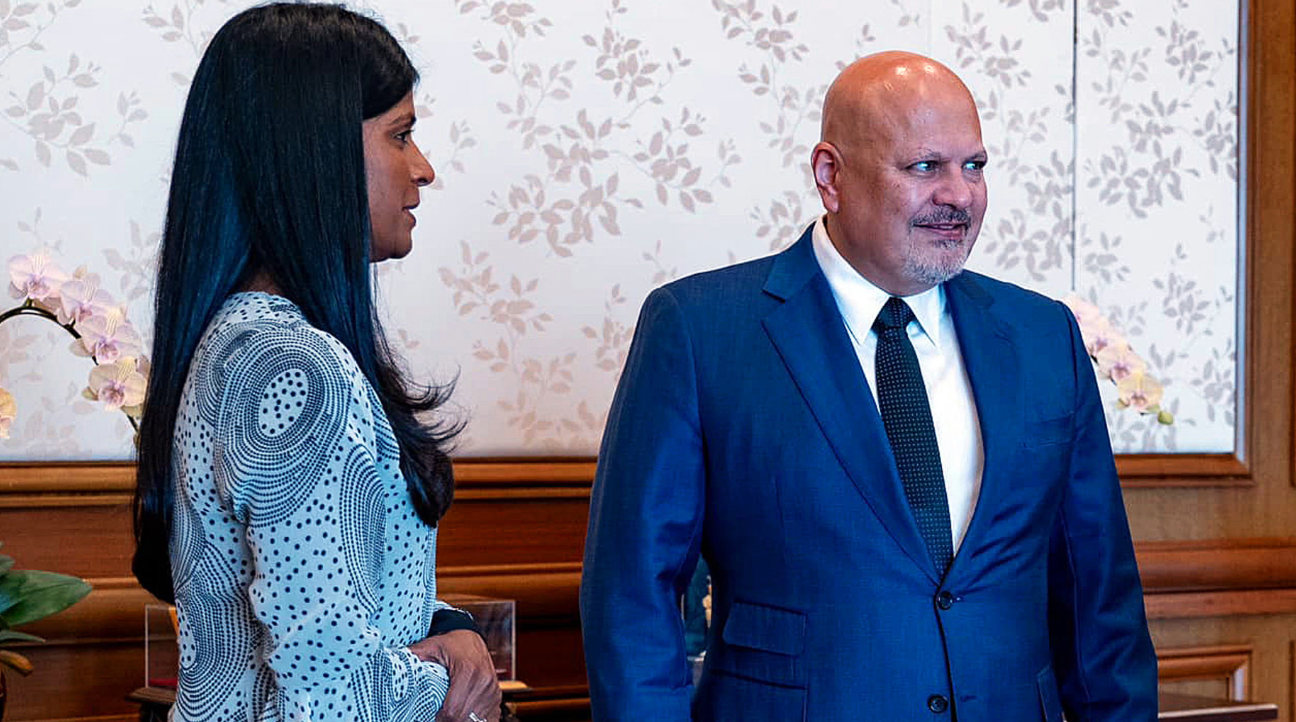
ICC Chief Prosecutor Karim Khan has been suspended after member states voted he committed serious misconduct over sexual abuse allegations brought by a woman who worked under him at The Hague.
By Imran Malik | World & Justice Desk | MediaBites.com.pk
The man tasked with prosecuting the world’s most heinous crimes against humanity has himself been suspended for serious misconduct, in an unprecedented crisis that has shaken the International Criminal Court to its foundations.
Karim Khan, the British lawyer serving as Chief Prosecutor of the International Criminal Court (ICC), was suspended Monday after the court’s governing body voted by qualified majority that he had committed serious misconduct in connection to sexual abuse allegations brought by a female colleague who worked directly under him.
What Khan Is Accused Of
The allegations were first made public in 2024 and relate to Khan’s conduct between 2023 and 2024. The woman, an ICC staff member based at the court’s headquarters in The Hague, alleged that Khan engaged in coercive and non-consensual sexual behaviour over an extended period.
The alleged misconduct reportedly took place across multiple locations including hotel rooms during work trips, Khan’s office at The Hague, and his private home — a pattern that prosecutors in other contexts would describe as systematic rather than incidental.
The ICC’s governing body based its decision on a United Nations watchdog report, advice from a panel of judicial experts, and written submissions understood to have been provided by both Khan and the alleged victim.
Khan Denies Everything
Khan, who has led the ICC’s prosecution department since 2021 and issued landmark arrest warrants including one against Russian President Vladimir Putin, has consistently and categorically denied the allegations.
His lawyers have previously stated he “categorically denies” having “harassed or mistreated any individual, or having misused his position or authority, or engaged in any conduct that could be interpreted as coercive, exploitative, or professionally inappropriate.”
The suspension, the ICC’s governing body stressed, is “not an indication of the final outcome.”
READ MORE:
Unprecedented Move for the World’s Court of Last Resort
The decision to refer proceedings to the ICC’s 125 member states for a special session is entirely without precedent in the court’s history. No chief prosecutor has ever faced removal proceedings of this nature before.
The special session could ultimately result in a vote to remove Khan from office permanently — a development that would mark one of the most dramatic falls from institutional power in the history of international law.
Khan had already temporarily stepped aside from day-to-day management of the ICC’s investigation and prosecution division while the inquiry was underway. Monday’s formal suspension removes even that partial operational role.
A Crisis Two Years in the Making
The allegations have embroiled the ICC for nearly two years, casting a shadow over every prosecution decision the office has made during that period. The court’s credibility, already tested by geopolitical pressures from powerful nations resistant to its jurisdiction, now faces an internal legitimacy crisis of its own making.
The ICC was founded on the principle that no individual, regardless of power or position, is above accountability for serious violations of human rights and international law. That the court’s own chief prosecutor now faces suspension over allegations of coercive sexual misconduct against a subordinate employee carries an irony that has not been lost on legal observers worldwide.
Why This Matters Beyond The Hague
The ICC’s institutional standing has direct consequences for ongoing investigations including those related to the Gaza conflict, Ukraine, and various African nations. Khan himself issued the arrest warrant against Israeli Prime Minister Benjamin Netanyahu and former Defence Minister Yoav Gallant last year, decisions that generated enormous international controversy.
The suspension raises immediate questions about the continuity and credibility of those prosecutorial decisions, the court’s ability to attract cooperation from member states, and whether pending cases will be affected by the leadership vacuum at the prosecution division.
For Pakistan, a signatory to the Rome Statute that established the ICC, the crisis is a reminder that international institutions derive their authority from perceived impartiality and institutional integrity — qualities that become infinitely harder to assert when the prosecutor is himself under suspension for serious misconduct.


2 Comments
Theo mình thấy thì nhà cái fly88 có nhiều nội dung giải trí khá đa dạng.
Theo mình thấy thì nhà cái fly88 có nhiều nội dung giải trí khá đa dạng.