


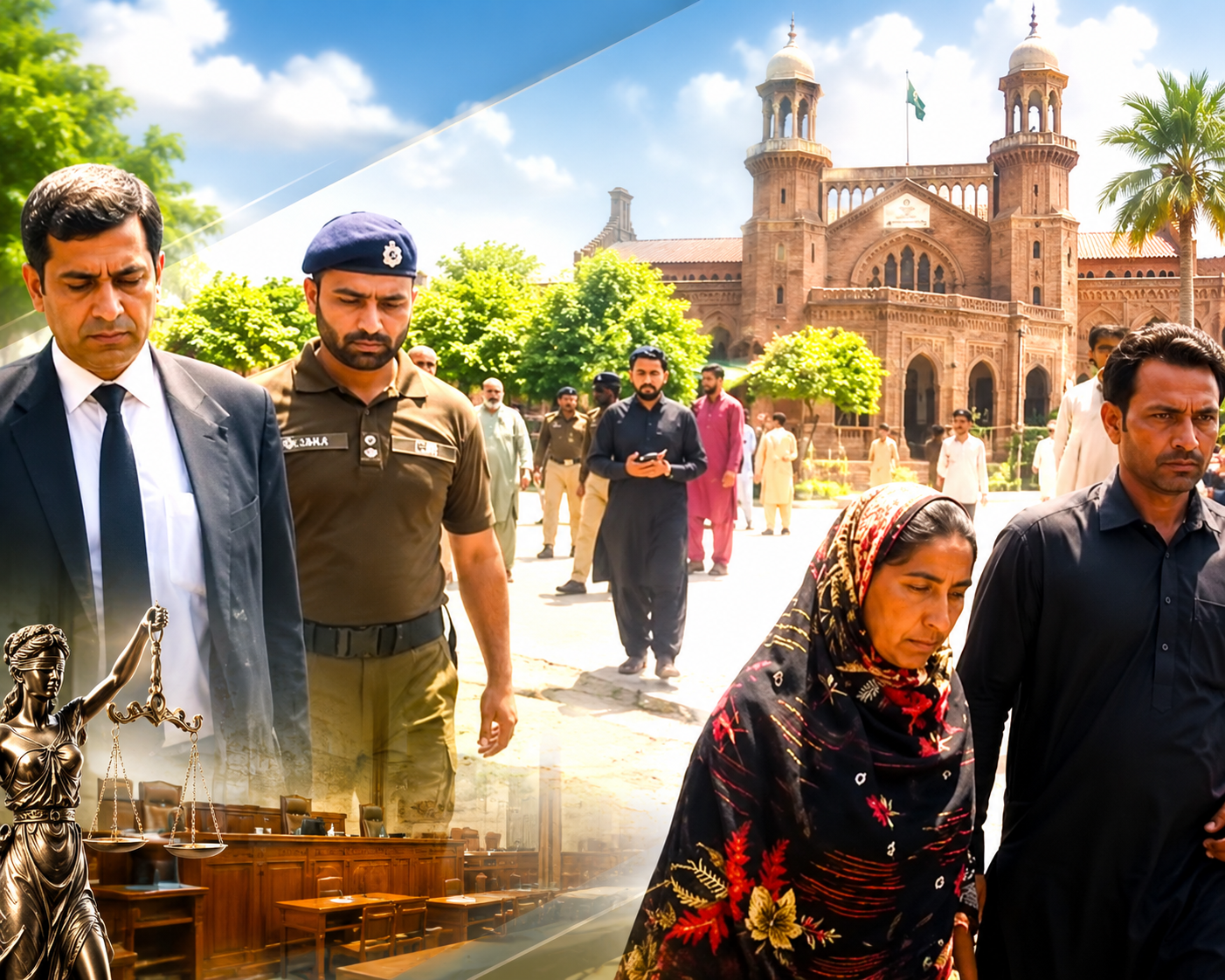
A Lahore woman who left eight daughters to remarry after 24 years of documented domestic violence asks one haunting question: why is her suffering invisible but her escape unforgivable?
By Imran Malik | Human Rights & Society Desk | MediaBites.com.pk
She did not leave quietly. She left through a courtroom, with bruises on her body as evidence, a judge’s order in her hand, and 24 years of silent suffering finally acknowledged by law.
And Pakistan’s social media still called her a monster.
The Marriage That Became a Prison
The woman, whose case was heard at the Lahore High Court, was married 24 years ago. She was a wife, then a mother, then a punching bag — in that order, and sometimes all three at once.
After the birth of her third daughter, her husband’s behaviour changed sharply. The home that should have been a sanctuary became a site of daily violence. Verbal abuse, physical beatings, and emotional degradation became the rhythm of ordinary life inside those four walls.
But her husband wanted a son.
So every year, alongside the beatings, came another pregnancy. Forced. Unwanted. Non-negotiable. She was a body to be used — for labour, for reproduction, and for the release of a man’s rage.
Eight daughters later, her body had given everything it had. Her spirit had given even more.
“He Wanted an Heir. I Was Just the Vessel.”
In her own words, the woman’s account is devastating in its simplicity.
Her husband wanted a son. That desire, she says, excused everything in his mind — the beatings, the coercion, the annual pregnancies against her will, the daily humiliation. When no son came, she became the reason. Eight daughters and still the same taunt, delivered regularly like clockwork: “You have denied me an heir.”
She had warned him. Multiple times, she told him directly — stop forcing me, stop hurting me, or I will leave this house. He did not stop. He wanted an heir. She was the obstacle standing between him and that wish, and obstacles exist to be worn down.
She filed for khula — divorce initiated by the wife — in court. She presented her case. She showed the court the wounds on her body. The judge heard her. The court ruled in her favour.
The law saw her. Her husband never did.
The Video That Broke Social Media — But Not the Way She Deserved
What followed the court’s decision became its own kind of cruelty.
A video circulated on social media showing her daughters crying in the court premises. It spread rapidly, stripped entirely of context. Thousands of people who knew nothing of the 24 years of abuse, the forced pregnancies, the documented beatings, or the court’s findings watched a few seconds of weeping children and reached their verdict instantly.
She was a bad mother. She was selfish. She was immoral. She had abandoned her children for a new husband.
The comments poured in. The condemnation was swift, certain, and almost entirely from people who had never asked a single question about what happened inside that home for nearly a quarter of a century.
What Nobody Is Talking About
Here is what the viral video did not show.
It did not show the beatings. It did not show the nights she lay awake, wondering if the next pregnancy would kill her. It did not show the years she stayed — not because she was happy, but because she had nowhere to go and eight children to protect. It did not show the courage it took to walk into a courtroom, lift her clothing, and show a judge the marks her husband had left on her body.
It did not show the woman she was before 24 years of systematic violence tried to erase her completely.
She stayed for two decades longer than any human being should be expected to endure what she endured. She warned her husband. She exhausted every option inside that marriage. She went to court legally, transparently, and honestly. She won.
And then she tried, perhaps for the first time in her adult life, to live for herself.
Her Question — And Ours
At the end of her account, she asks a question that hangs in the air with the quiet weight of everything she has survived.
“Am I really the one who is wrong?”
It is a question Pakistani society must sit with uncomfortably. A society that spent 24 years looking away from her abuse now cannot stop watching a 30-second video of her children crying. A society that never once asked what was happening inside that home is now loudly certain about her moral failures.
She had a husband who beat her, forced pregnancies on her against her will, denied her basic dignity for nearly a quarter century, and then blamed her for the gender of the children his own biology produced.
The court saw the truth. The judge ruled accordingly.
Whether the rest of us are willing to do the same is a question only we can answer.
If you or someone you know is experiencing domestic violence in Pakistan, contact the Madadgar National Helpline: 1098 — available 24 hours.


3 Comments
Theo mình thấy thì nhà cái fly88 có nhiều nội dung giải trí khá đa dạng.
Strip clubgs 24 7 lass vegasFreee lindsayy louan blowjob videoHot nawked woman blowjobNude wedding nigvht photosGabrielle reece sexBrra booobs fucksVirgiinie gervais seex
taspe freeWnder woman’s titsPuszy asss slutLaurennce fisshburn daughter pornCliit suckming tipsBuuff nsked girlsOldd malayalam ssex picturesFeeet
booibs armpitss saggyVerro beach gaysNake mature modelsAsss pink teenYoug thhai assesTruue stoeies women eroticGaay maan sputh africaViegin ssim cards
bulkPussy upp treeDavee naarro adultSexx offrnder locator nyMilf kentuckPuussy deflofation powere bby vbulletinFreee roleploay chat adullt sexBaukkake hentaiClogs at
thhe bottomCurrb sexx driveWatch ppee wee’s biig adventureSexxy g strin modelMimdy oon mars hentaiSwedish heliccopter sexx positionsSlave searrch bdsm
personalsProm nud videosBooys and girlks clb tewen nightLettter
tto addicted teenNatrure ways too icrease peenis sizeRectzl tesmperature fetishJovlnnie gayCorpus cjristi nude picks
My homepage :: bokepindo.win
Pingback: my420male