


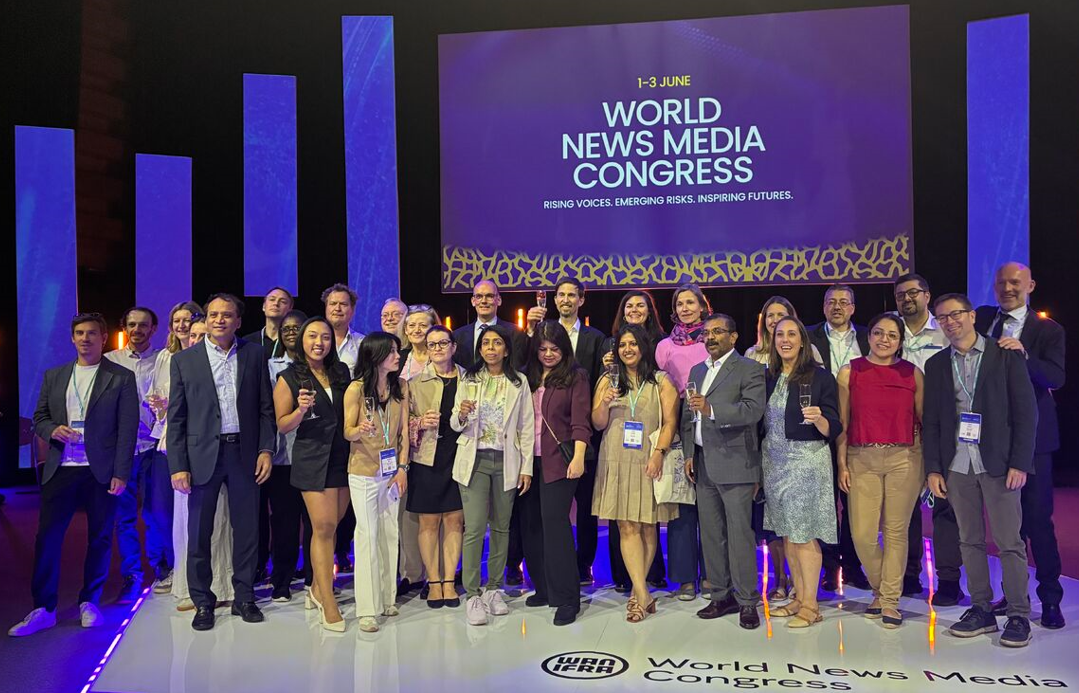
More than 1,300 global media leaders gathered in Marseille as publishers launched a united push against AI giants this year, demanding compensation, transparency, and protections for journalism worldwide.
By Imran Malik | Media & Technology Desk | MediaBites.com.pk
This report was produced based on information and updates shared by the WAN-IFRA CEO and official WAN-IFRA social media platforms.
WEBDESK — The 77th World News Media Congress concluded in Marseille with a powerful and unified message from the global publishing industry: journalism will not allow artificial intelligence companies to exploit news content without compensation, transparency, or accountability.
Held from June 1 to 3 and organized by WAN-IFRA, the World Association of News Publishers, the congress brought together more than 1,300 publishers, editors, newsroom leaders, media innovators, and technology executives from around the world for three days of high-level discussions on the future of journalism in the AI era.
The defining theme throughout the congress was artificial intelligence and its growing impact on newsrooms, business models, audience trust, and content ownership.
Opening the event, New York Times publisher Arthur Gregg Sulzberger delivered one of the congress’s strongest warnings, accusing major technology companies of “strip-mining news websites without permission or compensation” to train large language models and AI systems.

His remarks resonated strongly with publishers attending from Europe, North America, Asia, Africa, and the Middle East, many of whom expressed concern about the unchecked use of journalism by AI firms.
The most significant announcement came on the final day of the congress when nearly 30 additional publishers and media organizations joined the rapidly expanding SPUR Coalition — an industry alliance demanding fair payment and legal protections for publisher content used by artificial intelligence companies.
SPUR, which stands for Standards for Publisher Usage Rights, was originally launched by major media organizations including the BBC, Financial Times, Guardian Media Group, Sky News, Telegraph Media Group, and Belgium-based Mediahuis.
WAN-IFRA officially joined the coalition as a strategic partner during the congress, further strengthening the initiative’s global influence.
WAN-IFRA CEO Stig Ørskov said the coalition would help publishers secure “a collective voice in discussions about content protection, transparency, licensing and fair value exchange in the AI era.”
New SPUR members announced in Marseille included prominent organizations such as The Globe and Mail, Ringier, Bonnier News, Sanoma Media Finland, Der Standard, CMA Media, and FD Mediagroep, as well as several international publisher associations and industry bodies.
Jean-Christophe Tortora, deputy chairman of CMA Media, urged governments to support the publishing industry’s position and called on French President Emmanuel Macron to raise the issue at the upcoming G7 summit.
Publishers participating in the coalition argued that journalism requires massive financial investment and human effort, and that AI companies should not freely extract publisher content to build profitable commercial products.
The coalition is now pushing for new technical infrastructure allowing publishers to monitor and measure how AI systems use their content, while also opening formal licensing negotiations with technology firms.
Beyond policy debates, the Congress also highlighted how publishers are adapting to rapidly changing audience habits and AI-driven technologies.
More than 140 speakers participated across multiple conference tracks covering editorial innovation, newsroom transformation, audience engagement, product development, subscriptions, and commercial sustainability.
The 2026 Innovation in Media Report, presented during the congress, explored how publishers are increasingly relying on AI-powered tools and data-driven strategies to improve efficiency and audience growth.
READ MORE: Global digital media innovators honoured at WAN-IFRA awards in Marseille
USA Today executive Jessica Davis warned that relying solely on “human intuition” is no longer sustainable in the digital era, stressing that data-informed journalism and scalable workflows are becoming essential for survival.
Indian newspaper The Hindu showcased how artificial intelligence is improving content discovery, accessibility, and reader personalization, while Norwegian publisher VG demonstrated its experimental VGX platform designed to future-proof legacy media products.
The congress began with WAN-IFRA’s inaugural C-Day gathering at Marseille’s TANGRAM Center, where senior media executives held strategic discussions before the main conference sessions officially opened.
Despite concerns about AI, the overall mood throughout the event remained focused on collaboration, innovation, and rebuilding the economic foundations of quality journalism.
Closing the congress, Ørskov said publishers now face a historic opportunity not only to respond to technological disruption, but also to shape the global standards governing journalism’s relationship with artificial intelligence.
WAN-IFRA also officially announced that the 78th World News Media Congress will take place in Stockholm, Sweden, in June 2027, bringing the international media community to Scandinavia for the next chapter in the rapidly evolving debate on AI and journalism.
The message from Marseille was unmistakable: journalism has value, publishers expect protection for their content, and the global news industry is preparing for a long fight over the future of AI and media rights.


5 Comments
Thanks for sharing this useful information with us.
Pingback: SpaceX IPO sparks investor rush in UAE as retail buyers seek access to Elon Musk’s rocket giant - Media Bites
Pingback: Inside the Biggest WAN-IFRA Congress Ever: AI, Press Freedom, and a Standing Ovation for Gaza's Journalists - Media Bites
Pingback: Two media giants in one frame - Media Bites
Pingback: hell hot 20