


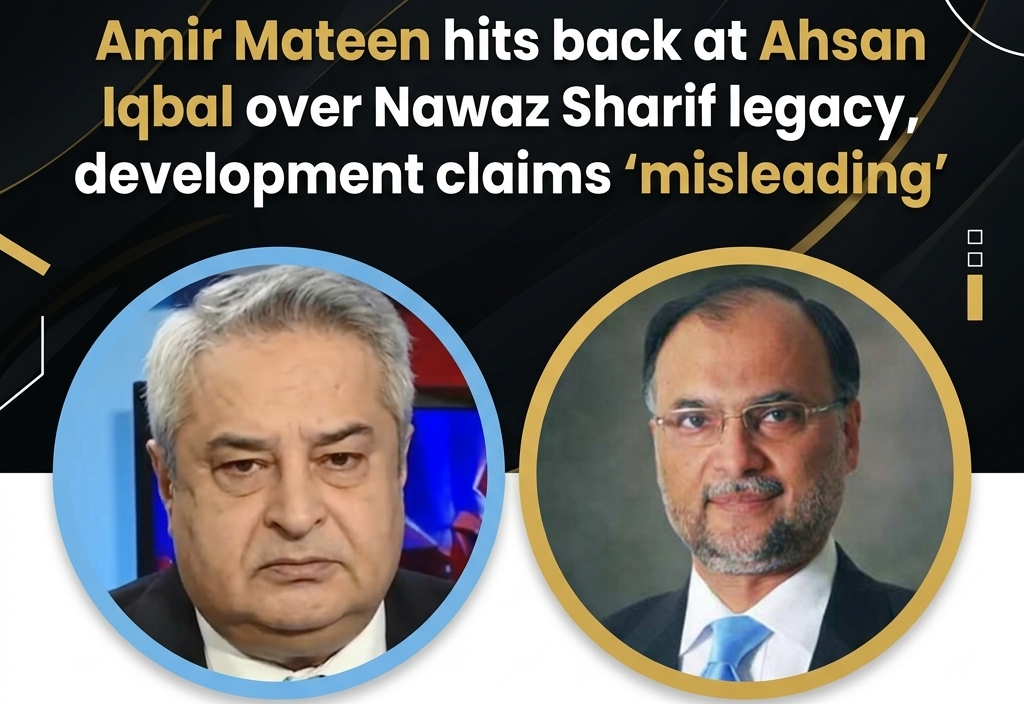
Senior journalist Amir Mateen strongly rebuts Ahsan Iqbal’s praise of Nawaz Sharif, blaming past policies for Pakistan’s debt crisis, energy issues, and worsening economic indicators.
MEDIABITES – Webdesk
A sharp public exchange has erupted between senior journalist Amir Mateen and Federal Minister Ahsan Iqbal, after the latter defended the economic legacy of Nawaz Sharif.
Responding to Iqbal’s statement praising Nawaz Sharif’s development record, Mateen launched a scathing critique, accusing the minister of promoting a “false narrative” and holding past policies responsible for Pakistan’s current economic crisis.
“Development model destroyed the economy”
Mateen argued that the much-celebrated development era under Nawaz Sharif had, in reality, pushed Pakistan into a deep debt trap. He pointed to what he described as flawed planning decisions and questioned the long-term sustainability of major projects.
According to him, two key areas — energy and infrastructure — became the root of ongoing financial stress.
IPP contracts under fire
Mateen criticized Independent Power Producer (IPP) agreements from the 1990s and later years, alleging they were structured to prioritize private gains over the national interest.
He claimed Pakistan continues to pay over Rs2 trillion annually in capacity payments, even when electricity is not produced, calling it a “structural injustice” embedded in policy.
Despite an installed capacity of around 46,000 MW, he noted that actual generation remains significantly lower, raising questions about efficiency and planning.
Loans vs development debate
On infrastructure, Mateen challenged the narrative of road-building achievements, arguing that such projects were largely financed through external borrowing, increasing Pakistan’s debt burden rather than strengthening the economy.
He contrasted this with regional examples, suggesting Pakistan relied heavily on dollar-based loans for comparatively smaller infrastructure expansion.
Economic indicators questioned
The journalist further highlighted rising debt levels, claiming Pakistan’s total debt surged from around Rs44 trillion to Rs80 trillion in recent years. He also pointed to worsening poverty, unemployment, and agricultural decline as indicators of policy failure.
Rejecting Iqbal’s claim that governments were not given enough time, Mateen argued that ample political space existed in recent years without institutional resistance.
Open challenge
In a direct challenge, Mateen invited Iqbal for a public debate, urging him to defend his claims with facts rather than “propaganda.”
The exchange comes after Iqbal reiterated that his party had consistently driven Pakistan’s development and that disruptions in policy continuity prevented long-term economic success.
Growing political narrative battle
The clash reflects a broader debate over Pakistan’s economic direction, with competing narratives emerging over who is responsible for the country’s debt, energy crisis, and stalled growth.
As political tensions intensify, such public confrontations are likely to shape the discourse ahead of future policy decisions — and possibly, electoral battles.


2 Comments
Pingback: โดจิน
Pingback: purchase psilocybin Hamburg