


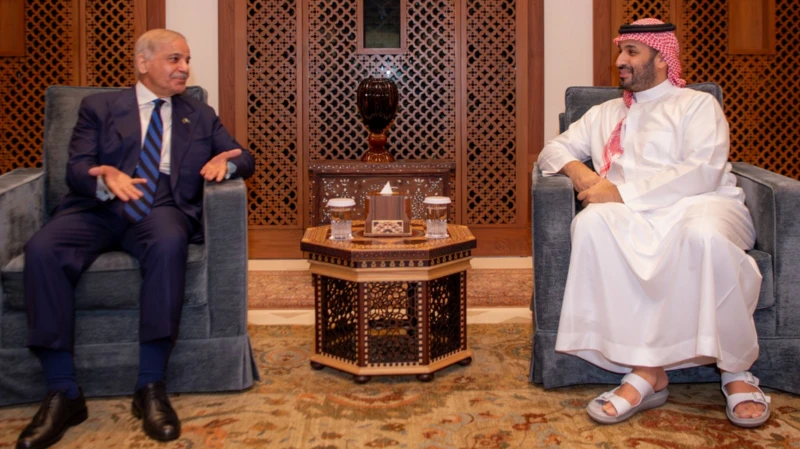
Prime Minister Shehbaz Sharif and Army Chief Asim Munir met Saudi Crown Prince Mohammed bin Salman as rising Iran war tensions spark concerns over Pakistan’s strategic interests and regional stability.
WEBDESK – Source: BBC Urdu / MediaBites News
Pakistan’s Prime Minister Shehbaz Sharif and Army Chief Asim Munir held a high-level meeting with Saudi Crown Prince Mohammed bin Salman in Riyadh amid escalating tensions in the Middle East following the ongoing conflict involving Iran.
The meeting came shortly after Prime Minister Sharif held a telephone conversation with Iranian President Masoud Pezeshkian, highlighting Pakistan’s attempt to maintain diplomatic balance as the regional crisis deepens.
According to a statement issued by Pakistan’s government, Sharif thanked Saudi Arabia for its long-standing support to Pakistan and reaffirmed Islamabad’s solidarity with the Kingdom during a time of regional uncertainty.
The statement said both leaders discussed the implications of the current military tensions on global and regional security and emphasized the importance of stability in the Middle East.
High-level delegation present
The meeting was attended by senior officials from both countries. On the Saudi side, Khalid Al-Humaidan, head of the General Intelligence Directorate, was present.
Pakistan’s delegation included Deputy Prime Minister and Foreign Minister Ishaq Dar, along with senior military leadership.
Growing tensions in the Middle East
The diplomatic engagement comes at a time when tensions between Iran, the United States, and Israel have intensified following military exchanges in the region.
Iran has reportedly targeted American military bases in response to joint actions by the United States and Israel, raising fears that the conflict could expand across the Middle East.
Pakistan attempting delicate diplomacy
Security analysts say Pakistan is attempting to pursue quiet diplomacy to prevent further escalation.
According to Pakistan Institute for Conflict and Security Studies Director Abdullah Khan, Islamabad has been maintaining back-channel communications with Saudi Arabia and other Arab partners to ensure they do not become directly drawn into a wider conflict with Iran.
At the same time, Pakistan is also trying to persuade Tehran that expanding the conflict further may not serve its long-term interests.
Earlier, Foreign Minister Ishaq Dar confirmed that Pakistan had reminded Iran of its defense cooperation agreement with Saudi Arabia, signaling Islamabad’s sensitive balancing act between two key regional partners.
Strategic risks for Pakistan
Analysts warn that a wider Iran conflict could create serious strategic challenges for Pakistan.
One major concern is the potential disruption of oil and cargo shipments through the Strait of Hormuz, a vital global energy corridor. Any prolonged disruption could affect Pakistan’s already fragile energy supplies and trade routes.
Experts also point to possible security implications along Pakistan’s border regions, particularly due to developments in Iran’s Sistan and Baluchestan, which shares a frontier with Pakistan’s Balochistan province.
Strategic projects such as Gwadar Port could also face heightened security risks if regional tensions escalate further.
Calls for careful diplomacy
Veteran Pakistani politician Mushahid Hussain Syed said Pakistan must handle the evolving crisis with “skill and diplomatic caution” to avoid becoming entangled in a broader regional conflict.
Observers say Islamabad’s current approach reflects a delicate effort to maintain relations with both Iran and Saudi Arabia while safeguarding Pakistan’s strategic interests during one of the most volatile periods in the Middle East in recent years.

