


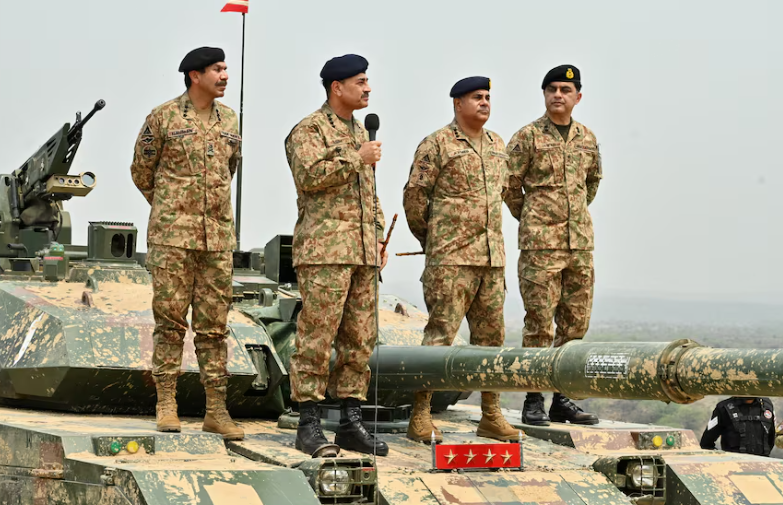
Pakistan Army Chief Asim Munir remains in global focus as his leadership, frontline presence, and strategic decisions shape Pakistan’s military posture amid rising regional and international pressures.
WEBDESK – REUTERS – December 17, 2025
Pakistan’s powerful military chief, Field Marshal Asim Munir, has emerged at the center of a growing geopolitical debate as the United States presses Islamabad to consider contributing troops to a proposed Gaza stabilisation force, a move analysts say could provoke unrest at home.
Munir is expected to visit Washington in the coming weeks to meet U.S. President Donald Trump, marking their third meeting in six months, according to sources cited by Reuters. The discussions are likely to focus on Trump’s controversial 20-point Gaza plan, which calls for troops from Muslim-majority nations to oversee a transition period for reconstruction and economic recovery in the war-torn Palestinian territory.
The plan envisions an international force playing a role in stabilising Gaza and disarming Hamas, a prospect that many countries view as politically risky and potentially destabilising.
Analysts say Pakistan’s decision will place Munir in a difficult position. Refusing to contribute could strain relations with Washington, while sending troops could inflame public opinion in a country where pro-Palestinian sentiment runs deep.
“Not contributing could annoy Trump, which is no small matter for a Pakistani state keen to stay in his good graces, particularly to secure U.S. investment and security assistance,” said Michael Kugelman, a South Asia analyst at the Atlantic Council.
Pakistan, the only Muslim-majority country with nuclear weapons, has one of the region’s most battle-hardened militaries, having fought multiple wars with India and ongoing campaigns against militant groups. That military capacity, analysts say, increases pressure on Munir to deliver.
Earlier this month, Munir was appointed Chief of the Defence Forces, giving him command authority over the army, navy, and air force, along with a job extension until 2030. Constitutional amendments passed by parliament also grant him lifetime legal immunity, cementing what observers describe as unprecedented authority.
“Few people in Pakistan enjoy the freedom to take risks the way Munir does,” Kugelman said. “His power is now constitutionally protected.”
However, the domestic risks remain high. Islamist parties, many fiercely opposed to the U.S. and Israel, retain strong street-mobilisation power. Analysts warn that any Pakistani troop presence in Gaza under a U.S.-backed framework could quickly spark protests and political instability.
“There is a strong likelihood that critics would frame it as Pakistan doing Israel’s bidding,” said Abdul Basit, a security analyst based in Singapore. “It would be naïve to think that reaction would not come.”
Pakistan’s foreign minister has previously said Islamabad could consider peacekeeping roles but stressed that disarming Hamas is not Pakistan’s responsibility.
As Pakistan navigates renewed closeness with Washington, Munir’s handling of the Gaza issue is shaping up to be one of the most consequential tests of his leadership, balancing global diplomacy against volatile domestic realities.


2 Comments
Pingback: Judge’s Son Kills Two Girls and Walks Free in Islamabad - Media Bites
I really like your writing style, superb information, regards for putting up : D.