


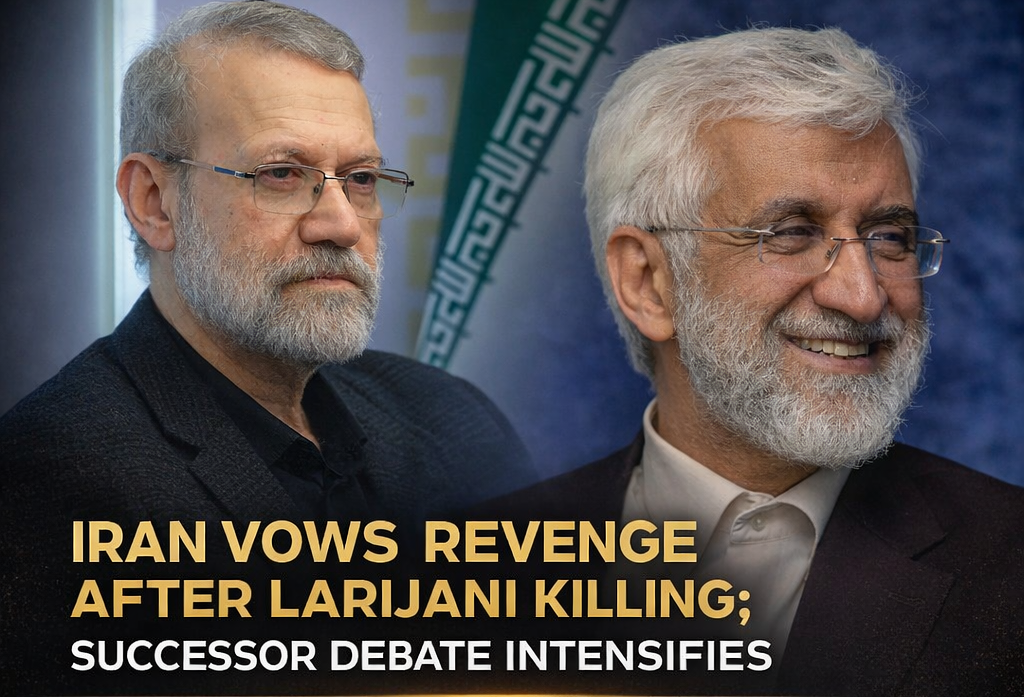
Iran vows revenge after Ali Larijani’s assassination in an Israeli strike, as missile attacks intensify and attention shifts to who will replace the powerful security chief.
MediaBites Editorial – Source: CNN
Iran has vowed a “decisive and regrettable” response after one of its most influential power brokers, Ali Larijani, was assassinated in an Israeli strike—an attack that has sharply escalated tensions across the Middle East and triggered a new phase of uncertainty within Tehran’s leadership.
Iran promises revenge as strikes intensify
Iranian military leaders issued stark warnings following Larijani’s death, signaling that retaliation is already underway and could intensify further. Major General Amir Hatami declared that the killing would be avenged, calling the response “decisive and regrettable” for Israel and its allies.
Iranian state media claimed ballistic missile attacks targeting central Israel—including Tel Aviv—were carried out in retaliation. At least two people were reported killed, while Israeli defenses intercepted multiple incoming projectiles.
The situation has spiraled into a broader confrontation:
The United States, under President Donald Trump, struck Iranian missile sites near the Strait of Hormuz using 5,000-pound guided bombs
Renewed attacks were reported near the US Embassy in Baghdad
Iran’s paramilitary Basij force also lost its chief in the Israeli strike
Senior Iranian commander Ali Abdollahi warned Washington to “wait for surprises,” raising fears of a wider regional conflict.
A major power vacuum in Tehran
Beyond the battlefield, Larijani’s death has created a critical leadership vacuum at the heart of Iran’s decision-making structure.
Widely seen as a pragmatic strategist, Larijani played a unique role bridging factions within Iran’s political system while managing sensitive negotiations abroad. His absence leaves a gap that will be difficult to fill at a time of war.
Under Iranian law, President Masoud Pezeshkian is responsible for appointing the next national security chief. But the decision is expected to reflect deeper power dynamics shaped by the Supreme Leader and the Islamic Revolutionary Guard Corps (IRGC).
Saeed Jalili emerges as top contender
Among the leading candidates is Saeed Jalili, a senior figure known for his hardline stance against the West.
Jalili’s credentials include:
- Former national security advisor
- Chief nuclear negotiator
- Member of the Expediency Discernment Council
However, analysts caution that his appointment could mark a sharp ideological shift. Unlike Larijani’s pragmatic approach, Jalili is widely viewed as rigid and uncompromising—traits that could limit Iran’s diplomatic maneuverability at a critical moment.
Experts also point out that the IRGC—now holding significant influence—may prefer a candidate with stronger military credentials, reflecting the country’s wartime posture.
Strategic implications for the region
Whoever replaces Larijani will play a decisive role in shaping Iran’s next moves—both militarily and diplomatically.
The position is central to:
War strategy and coordination
Potential negotiations with the US and Israel
Internal balance of power between hardliners and pragmatists
With Iran signaling revenge and Israel bracing for further attacks, the leadership transition in Tehran could determine whether the crisis escalates into a prolonged regional war—or opens a narrow path toward de-escalation.
For now, both fronts—military retaliation and political succession—are unfolding simultaneously, raising the stakes across an already volatile Middle East.


2 Comments
Mình từng tìm hiểu qua fly88 com, thấy giao diện khá thân thiện với người dùng.
I truly appreciate your technique of writing a blog. I added it to my bookmark site list and will