


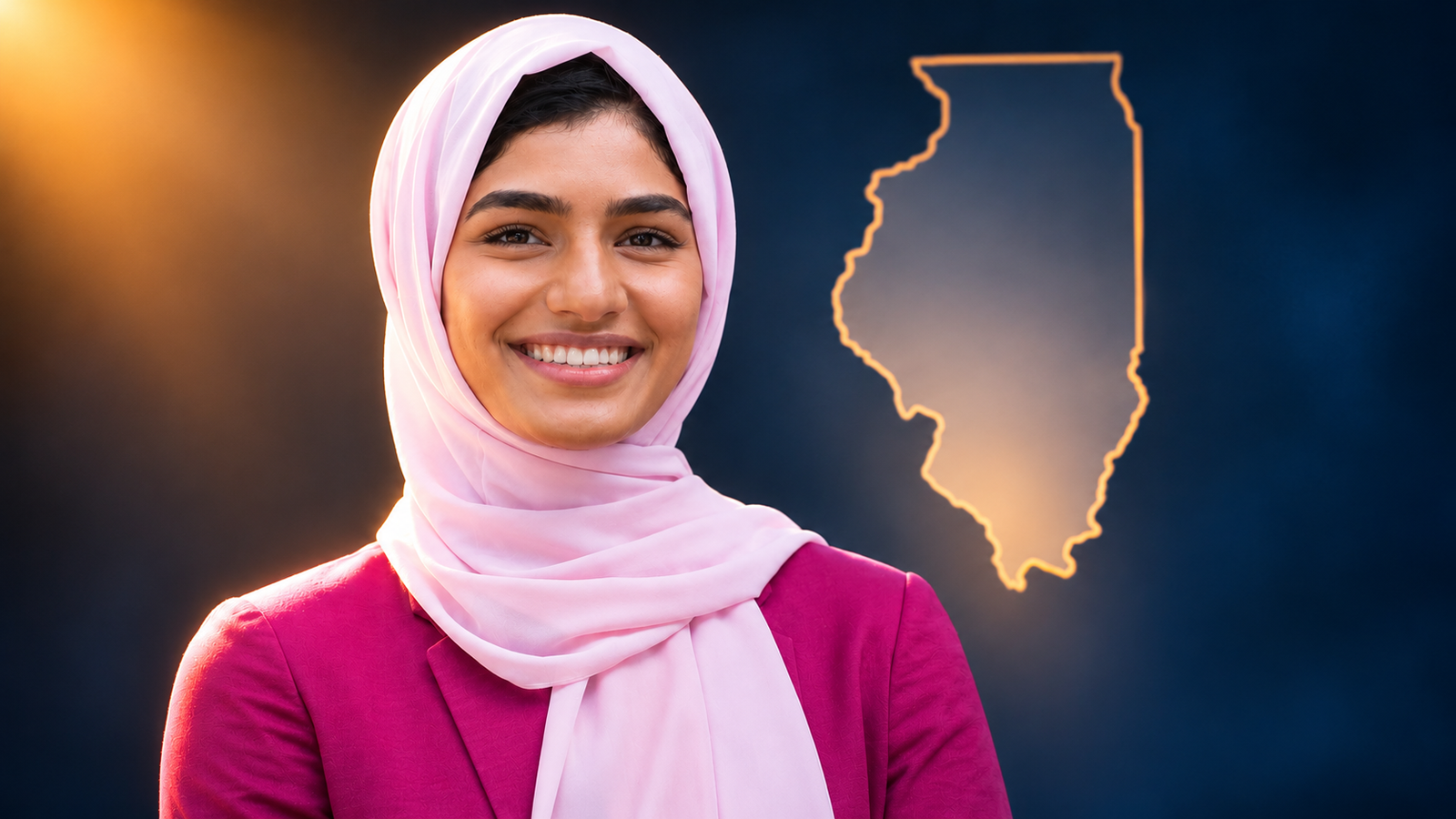
Nabeela Syed, 27, daughter of Hyderabadi immigrants, won an Illinois State Senate seat by flipping a Republican district, becoming a symbol of Muslim American political representation.
WEBDESK – MEDIABITES – MAKTOOB
Nabeela Syed flips Republican-held district in one of Illinois’s most expensive legislative races, adding to a historic midterm night for Muslim Americans
PALATINE, Illinois — Nabeela Syed, the 27-year-old daughter of immigrants from Hyderabad, India, has defeated Republican incumbent Darby Hills to win a seat in the Illinois State Senate, adding another chapter to what is shaping up as a landmark night for Muslim American political representation across the United States.
Syed’s victory in the 26th Senate District came in one of Illinois’s most expensive state legislative contests, with candidates raising $6.5 million in contributions. Her campaign focused on affordability, healthcare, and the region’s rapid expansion of data centers.
Addressing supporters after her win, Syed framed the moment in terms that went beyond party politics, as an elderly woman in the crowd wiped away tears.
“You don’t see young women of color flipping Republican-held seats,” she said.
Her mother had a simpler explanation for why she ran. “My mother said if I didn’t do it, who would?”
From Palatine to the State Senate
Syed was born and raised in Palatine, Illinois, the daughter of parents who immigrated from Hyderabad in the 1980s. She first entered electoral politics in 2022, at age 23, winning a seat in the Illinois House of Representatives and becoming the youngest lawmaker in the state’s history. She retained that seat in 2024 before contesting the State Senate.
She graduated from the University of California, Berkeley, with a double major in Political Science and Business Administration. She wears a hijab, a choice she made in Class 9 that her father initially worried might expose her to bullying. She has said it became one of the defining moments in building her own sense of agency.
In 2017, she was crowned prom queen at her school.
‘Someone tried to spit on me’
The road to elected office was not without its ugliness. Syed has spoken openly about the discrimination she faced growing up Muslim in post-September 11 America, being called a terrorist as a young girl, and an incident in Washington, DC, during an internship in which someone attempted to spit on her.
“Those instances are what happened when you normalize hate,” she told Maktoob magazine in a 2022 interview. “It was upsetting for me.”
She entered politics after Donald Trump’s 2016 presidential election victory, which she said made her feel she “no longer belonged” in the country where she was born and raised. After seeing far-right candidates run for school board seats, she began managing campaigns for progressive candidates and eventually decided to run herself.
“Someone who looks like me, someone who is Indian, who is Muslim, and who is young, needs to be involved in the political space here in America,” she said.
A legislative record on healthcare and education
In her time in the Illinois House, Syed authored legislation capping prescription drug costs, championed the Generic Drug Pricing Fairness Act, making Illinois one of the first states to ban price gouging on generic medications, and passed bills expanding breast cancer screening coverage, eliminating prior authorization for outpatient mental health treatment, and prohibiting community colleges from replacing professors with artificial intelligence.
On education, she secured $350 million in new state funding for K-12 public schools and worked to expand access to preschool through Smart Start Illinois.
“Healthcare is a fundamental human right,” she has written. “No one should be forced to choose between paying rent, buying groceries, or life-saving medications.”
Syed’s victory came on the same night that Abdul El-Sayed made history in Michigan, becoming the first Muslim ever elected to the United States Senate. Together, the two wins represent a broader shift in Muslim American political representation, one that has come despite, and in direct response to, years of intensifying Islamophobic rhetoric in American public life.
“Our children, years from now, will be able to run for office, to be seen as who they are,” Mohamed Gula of the Muslim American advocacy group Emgage Action said following El-Sayed’s victory.
Nabeela Syed’s story suggests that the future is already here.

