


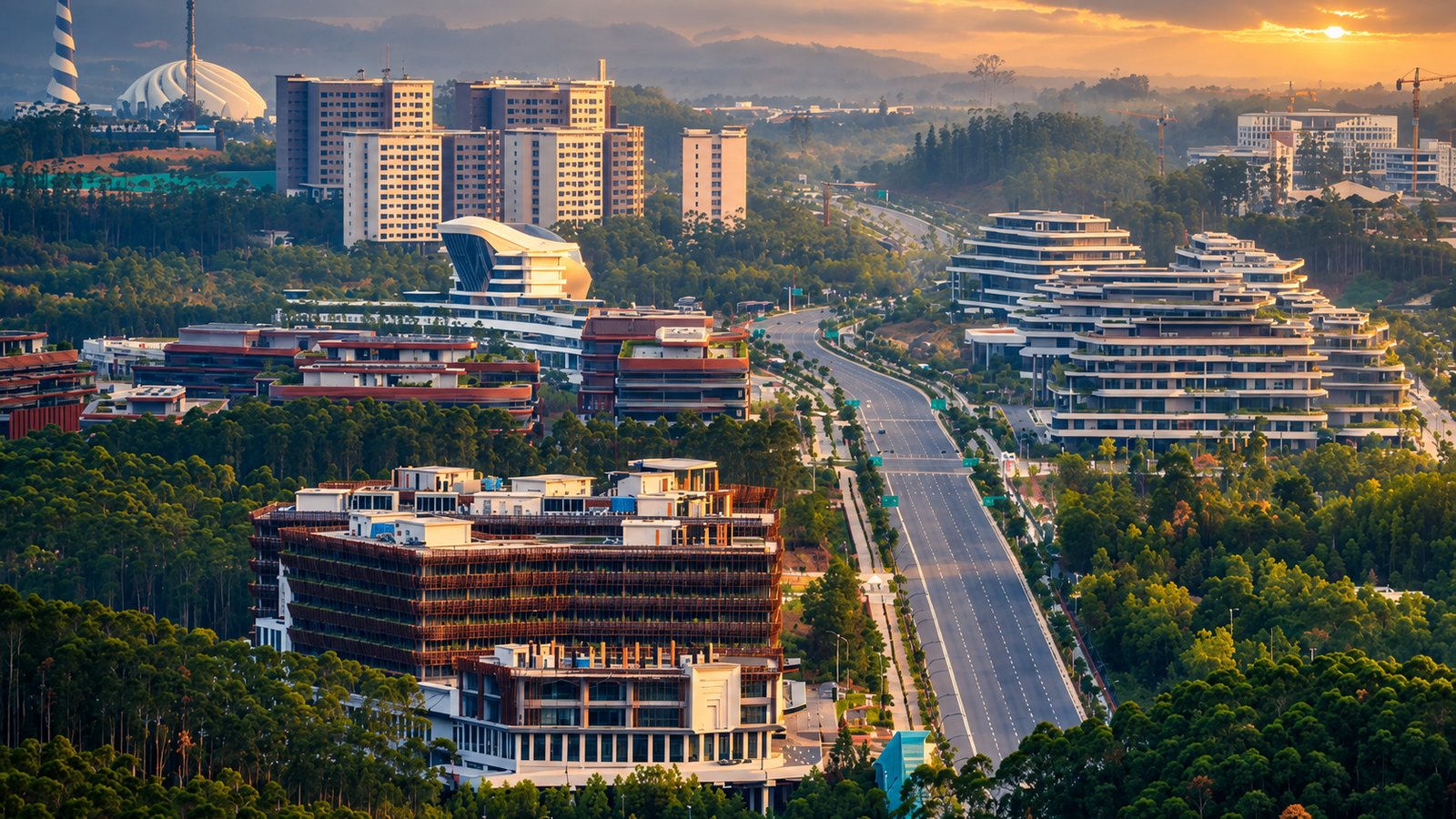
Indonesia’s ambitious Nusantara capital project faces funding cuts and uncertain political backing as the sparsely populated new city in Borneo raises questions about its future and the billions invested.
WEBDESK – MEDIABITES
Indonesia: Indonesia’s ambitious plan to build a new capital city in the forests of Borneo faces mounting questions over funding, political commitment, and whether the multibillion-dollar project can attract enough residents to fulfill its original promise.
Nusantara, located in East Kalimantan more than 1,200 kilometers from Jakarta, was conceived as a modern, environmentally conscious administrative center that would reduce pressure on Indonesia’s overcrowded capital and encourage economic development beyond the island of Java.
But despite billions of dollars spent on construction, much of the new city remains strikingly quiet, with largely empty roads, limited entertainment options and relatively few permanent residents in its newly built residential towers.
The project, estimated to cost about $45 billion, was launched under former president Joko Widodo, widely known as Jokowi, who announced the relocation plan in 2019. Construction began in 2022, aiming to develop a city capable of accommodating 1.9 million people by 2045, when Indonesia marks its centenary of independence.
Funding cuts raise questions over the project
Nusantara’s future has become less certain since President Prabowo Subianto succeeded Jokowi in October 2024.
Government spending on the project fell from about 43 trillion Indonesian rupiah in 2024 to 13 trillion rupiah in 2025 and 6.3 trillion rupiah in 2026, according to the report.
Prabowo has redirected government resources towards other priorities, including a nationwide school meals program, while analysts have pointed to differences between the current president and his predecessor over the development’s future.
Although Prabowo has signed a presidential regulation targeting Nusantara’s designation as the political capital by 2028, Indonesia’s Constitutional Court ruled that Jakarta would remain the official capital until an additional presidential decree is issued.
The unresolved legal and political questions have added uncertainty for investors and government departments preparing to relocate.
A new city with few residents
The wider Nusantara administrative area, which includes surrounding villages and sub-districts, has a population of about 147,000. However, the newly developed urban core has only around 1,800 residents, mainly civil servants and defense and security personnel.
Authorities are gradually relocating government workers and recruiting younger employees to establish a permanent community.
Ranty Wiyati, a young worker with the Nusantara Capital Authority, said the quieter environment offered a different lifestyle from Jakarta, where congestion, pollution and overcrowding are major concerns.
She described the city as an opportunity to build a more sustainable community, pointing to its water filtration systems, recycling requirements and monitoring of electricity and water consumption.
Jakarta, home to an estimated 42 million people in 2025, also faces a serious environmental challenge: about 40 percent of the city lies below sea level, leaving parts of its northern districts vulnerable to flooding.
Supporters argue that relocating government institutions could eventually help Nusantara attract businesses, workers and families.
Investors remain cautious
The original financing plan envisaged private investors covering 80 percent of the project’s cost, with the government providing the remaining 20 percent.
However, economist Bhima Yudhistira of the Center of Economic and Law Studies (CELIOS) has warned that limited investor appetite, higher interest rates, geopolitical uncertainty and policy risks could undermine the project’s financial sustainability.
He cautioned that Nusantara could become a “white elephant” — an expensive development that delivers limited economic benefits relative to its cost.
Public policy expert Agus Pambagio has also cited funding reductions and political uncertainty as factors slowing construction, expressing doubt that the city would become the capital by 2028.
The Nusantara Capital Authority disputes suggestions that the project has lost government support. Deputy chief Dr Alimuddin has maintained that financial backing and construction are continuing, while officials say private investors have committed $6 billion and another $10 billion has come through public-private partnerships.
2028 could be a defining moment
The coming years will test whether Nusantara can develop beyond a government administrative center into a thriving city with businesses, housing, public services and a substantial resident population.
For Indonesia, the stakes extend beyond building a new capital. The project is intended to ease Jakarta’s urban pressures, redistribute economic activity and create a new center of national administration.
But with spending reduced, private investment uncertain and the capital’s legal status unresolved, Nusantara’s future will depend on whether political commitments translate into sustained financing and actual relocation.
The question is no longer simply whether Indonesia can build a new city in the jungle. It is whether the country can turn that ambitious construction project into a functioning capital that justifies its enormous cost.

