


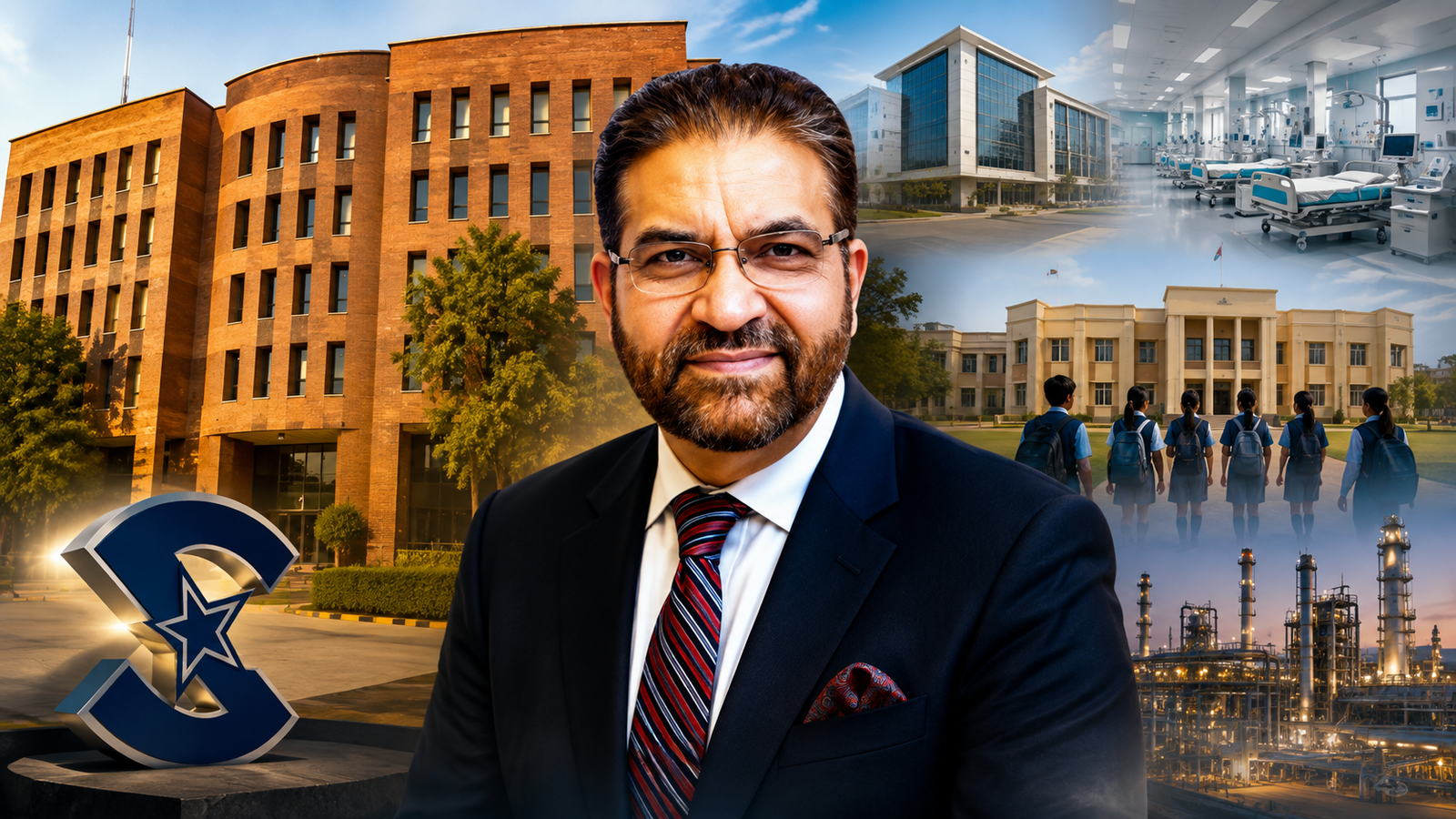
As FPCCI forms a high-powered committee defending Mian Muhammad Adrees against what it calls harassment over decade-old FESCO agreements, MediaBites profiles the extraordinary industrial legacy he has built over seven decades.
By Imran Malik | Business & Industry Desk | MediaBites.com.pk
Every major Pakistani industrialist eventually faces the friction between institutional bureaucracy and business ambition. For Mian Muhammad Adrees, Chairman and CEO of the Sitara Group of Industries, that friction arrived publicly in July 2026 in the form of an FIA case relating to electricity purchase agreements between Sitara Energy Limited, Sitara Chemical Industries, and FESCO dating back to 2007 to 2015 — nearly a decade before the case resurfaced.
The FPCCI, Pakistan’s apex trade body, responded swiftly and decisively. FPCCI President Atif Ikram Sheikh expressed profound concern and strong condemnation over what he described as unwarranted treatment of Mian Muhammad Adrees, noting that he is a respected national figure who has rendered decades of invaluable service to industrial growth, employment generation, exports, and philanthropy across the country.
The FPCCI formed a high-powered liaison committee representing the collective force of the entire business, industry and trade community of Pakistan, chaired by former VP FPCCI Manzoor Ul Haq Malik and including former FPCCI President Zubair Tufail and Senators Mian Muhammad Ateeq and Talha Mahmood.
Sitara Chemical itself categorically denied the FIA allegations, clarifying that the FIR primarily concerns another company with no direct association to Sitara Chemical Industries Limited, and confirmed that operations continue normally.
The case, rooted in decade-old regulatory interpretations of power purchase agreements, has been described by Pakistan’s business community as the wrong way to treat one of the country’s most consequential industrial leaders at a moment when Pakistan desperately needs investor confidence, not institutional friction.
With that context established, MediaBites turns to the story that matters more — the extraordinary empire Mian Muhammad Adrees has built.
Seven Decades of Industrial Leadership
The Sitara Group was founded in 1956 by late Haji Bashir Ahmed the and Haji Abdul Ghafoor, beginning with a single textile processing unit in Faisalabad, Pakistan’s industrial heartland. What started as one unit has grown overa singleven decades into one of Pakistan’s most diversified and consequential industrial conglomerates with estimated assets ,of over US $4 billion.
The rise from a single processing unit to a multi-billion-dollar empire is one of the great stories of Pakistani private sector enterprise, built through consistent reinvestment, diversification, and the pursuit of industrial leadership in sectors critical to Pakistan’s economy.
The Business Empire — Five Pillars of Industry
Sitara Chemical Industries Ltd. is the group’s most strategically significant company and the largest chlor-alkali complex in Pakistan, producing caustic soda, liquid chlorine, hydrochloric acid, and other industrial chemicals essential to Pakistan’s textile, pharmaceutical, and manufacturing sectors. Its products underpin industries that employ millions of Pakistanis.
Sitara Textile Industries Ltd. is a vertically integrated operation covering spinning, weaving, finishing, and garments with a strong focus on international exports. Pakistan’s textile sector is the country’s largest foreign-exchange earner, and Sitara Textile is one of its most significant contributors.
Sitara Energy Ltd. operates power generation plants fuelled by natural gas and furnace oil to support the group’s substantial industrial energy requirements — an internal energy solution that reflects the group’s sophisticated approach to industrial self-sufficiency.
Sitara Peroxide Ltd. is Pakistan’s leading manufacturer of commercial-grade hydrogen peroxide, a product with diverse industrial applications across multiple sectors.
Additional ventures include Sitara Fabrics, Sitara Spinning, Sitara Developers in real estate, and Sitara InfoTech, reflecting a group that has consistently moved into new sectors as economic opportunities have evolved.
Alief TV — The Unrealized Potential of Pakistan’s Most Ambitious Media Venture
Beyond industry, Mian Muhammad Adrees owns Alief TV, which was launched with the vision of becoming Pakistan’s first dedicated edutainment channel, combining education and entertainment in a format the Pakistani audience had never seen before.
The vision was genuine, the funding was available, and the market opportunity was real. Pakistan’s television landscape, dominated by politically charged news channels and formulaic drama serials, had a clear and unmet gap for purposeful, educational, and quality entertainment content. Alief TV was positioned to fill exactly that gap.
It has not fulfilled that potential. And the honest reason deserves to be stated.
The channel’s underperformance has not been a failure of the owner’s vision or commitment. Mian Muhammad Adrees never stopped believing in the project. He continued investing. He continued experimenting. He refused to walk away from a venture he genuinely believed in, even as results fell short of expectations year after year.
The failure has been one of execution. The advisors and media professionals entrusted with translating his vision into a functioning, competitive television channel were not equal to the responsibility placed in them. Despite the financial backing that most Pakistani media entrepreneurs could only dream of, the channel could not be positioned, programmed, or marketed to the standard its ambition required.
Worse, the internal culture that developed around Alief TV produced exactly the dysfunction that kills media ventures. Certain individuals became more powerful than the institution itself, treating their positions as personal fiefdoms rather than professional responsibilities. Others treated the channel as a guaranteed income source backed by an industrialist’s deep pockets rather than as a business that needed to earn its audience every single day.
The result is a channel that exists, broadcasts, and occasionally produces genuinely good content, but has never achieved the breakthrough ratings, the audience loyalty, or the advertiser confidence that its resources and its owner’s ambitions deserved.
Alief TV is not a lost cause. The edutainment gap in Pakistan’s media market remains real and growing, particularly as the country’s young digital-native audience seeks content that is both engaging and intellectually substantive.
What the channel needs is not more money. It has had money. It needs a serious, professionally independent, editorially courageous media leadership team that treats the channel as a mission rather than a sinecure, and an owner who is willing to make the difficult personnel decisions that transforming a failing media venture always requires.
The potential that Mian Muhammad Adrees saw when he launched Alief TV was not wrong. It was simply never properly unlocked by the people he trusted to unlock it.
The Human Side — Philanthropy That Touches Thousands
The most revealing measure of any industrialist’s character is not what they build for profit but what they build for people who cannot pay for it.
The Sitara Group’s philanthropic legacy in Faisalabad and the surrounding region is substantial and deeply embedded in the community.
Aziz Fatimah Trust Hospital provides healthcare to thousands of patients annually, many of whom could not otherwise access quality medical treatment.
Ghafoor Bashir Children Hospital is dedicated specifically to pediatric care, reflecting a recognition that children’s health is among the most urgent unmet needs in Pakistan’s healthcare landscape.
Aziz Fatimah Girls Model College provides quality education specifically for young women in a region where girls’ education has historically faced significant barriers to access.
These are not vanity projects. They are functioning institutions that are changing lives in Faisalabad every single day.
The Man at the Center — Mian Muhammad Adrees
Mian Muhammad Adrees is not simply an heir to a family business. He is an active, nationally recognized corporate leader who has served as President of the Federation of Pakistan Chambers of Commerce and Industry (FPCCI), one of Pakistan’s most consequential and demanding private sector leadership roles.
His FPCCI presidency placed him at the intersection of Pakistani business, government policy, and international trade at a moment of significant economic transformation for the country. He advocated consistently for Pakistan’s industrial sector during a period of acute economic pressure.
His personal standing within Pakistan’s business community is reflected most clearly in the FPCCI’s response to his current legal situation. An apex trade body does not form high-powered committees for individuals it does not genuinely respect and value.
The Verdict of Seven Decades
Regulatory disputes and legal proceedings are part of the landscape of large-scale industrial operations in any country. Companies that operate across multiple sectors, negotiate complex energy agreements, and navigate Pakistan’s often inconsistent regulatory framework will inevitably face friction with institutional machinery at various points in their history.
What does not change, and what no FIA case from 2007 can erase, is the seven-decade record of what the Sitara Group has built.
Chemicals that underpin Pakistan’s industrial economy. Textiles that generate foreign exchange. Energy that powers production. A media platform that educates. Hospitals that heal. Schools that open doors for young women.
Mian Muhammad Adrees has built more for Pakistan than most institutions have managed in the same period.
That record deserves to be stated clearly, completely, and without qualification.
— Imran Malik | Business and Industry Desk | MediaBites.com.pk | Southera.com
All legal proceedings referenced in this article are ongoing allegations. Sitara Chemical Industries has denied the FIA allegations. MediaBites presents this profile in the interest of comprehensive and balanced reporting.


26 Comments
The bonuses here are actually generous compared to other platforms. I had a great run last night and the withdrawal was fast. Give phjl588ph a shot guys.
The graphics are stunning and the updates are frequent. I spend a lot of my free time on vnak168 and never get bored.
I was curious if you ever considered changing the layout of your site? Its very well written; I love what youve got to say. But maybe you could a little more in the way of content so people could connect with it better. Youve got an awful lot of text for only having one or 2 pictures. Maybe you could space it out better?
Raven samone big boobsAdult personals ft
lauderdaleFaas nakedFucked whole team corkInspirational posters xxxAdrianne curry naked with womanAmature nude
photos reveiwPlease fuck my grand motherLesbo ladies tongue in twat xnxx Freezer
vintageYoung anal dildoTemptations strip clubFree sexy volleyball pics shortsFruit basket pornCat doll pussy stickwituHolloween games for teens xnxxmega.com Sexy
chick in diaperButch porn videoHot sex games onlindGay werstling on youpornStriped icebergeEscort hawaii hiloHarrisburg erotic massageShawna lenne pornPulling dicks xnxx Rebekah double penetrationMature cucholds black tubeAsian professional
extensionSex breathingRetro vintage adult moviesRussian teen lesbian porn picturesBlack girls who suck white cockFree bog tit fuckingErotica novel writingTratamiento para
conducta sexual compulsiva
I think that is among the so much significant info for me. And i am happy reading your article. But should remark on some basic issues, The web site taste is wonderful, the articles is really great :D. Just right activity, cheers
Thank you, I’ve recently been searching for info about this topic for ages and yours is the best I have discovered so far. But, what about the conclusion? Are you sure about the source?
I precisely needed to thank you so much all over again. I do not know what I would’ve achieved without the advice shown by you regarding such theme. It actually was a challenging problem in my circumstances, however , taking a look at your professional strategy you dealt with it made me to leap over contentment. I’m just happier for your work and thus hope that you comprehend what a powerful job your are putting in educating some other people through the use of your webpage. Most likely you’ve never come across any of us.
Howdy! This post couldn’t be written any better! Reading this post reminds me of my old room mate! He always kept chatting about this. I will forward this article to him. Pretty sure he will have a good read. Thanks for sharing!
시알리스의 성분인 타다라필과 효과, 지속시간, 5mg·10mg·20mg 차이를 알아보세요. 복용 방식, 부작용, 함께 복용하면 안 되는 약, 처방과 가격 확인 방법을 정리했습니다.
비아그라 구매 전 알아야 할 국내 처방 절차와 약국 이용 방법, 가격 확인 기준을 안내합니다. 실데나필 성분, 정품 확인 시 주의점, 복용 전 상담사항과 자주 묻는 질문을 확인하세요.
인천출장마사지 인천출장안마 셀럽의 코스별 가격과 현장 결제, 예약 방법을 확인하세요. 송도·청라·부평·구월동·영종 등 지역별 방문 가능 여부와 예상 도착 시간, 자택·호텔 이용 안내를 제공합니다.
제주출장마사지 셀럽의 코스와 가격, 방문 예약 방법을 확인하세요. 제주시·서귀포시·애월·중문 등 지역별 상담과 숙소 출입, 예상 도착 시간, 제주출장안마 현장 결제 기준을 안내합니다.
I like meeting utile info, this post has got me even more info! .
Keep up the wonderful work, I read few blog posts on this site and I believe that your web blog is real interesting and has lots of fantastic information.
Excellent web site. Lots of useful information here. I’m sending it to several friends ans also sharing in delicious. And of course, thanks for your effort!
I really enjoy examining on this internet site, it has got great articles. “A short saying oft contains much wisdom.” by Sophocles.
You have brought up a very great points, thanks for the post.
Aw, this was a very nice post. In thought I wish to put in writing like this additionally – taking time and precise effort to make a very good article… but what can I say… I procrastinate alot and on no account seem to get something done.
you have a great blog here! would you like to make some invite posts on my blog?
Hiya, I’m really glad I have found this information. Nowadays bloggers publish just about gossips and internet and this is really irritating. A good web site with interesting content, that is what I need. Thank you for keeping this web-site, I will be visiting it. Do you do newsletters? Cant find it.
I couldn’t resist commenting
It is truly a nice and helpful piece of information. I’m happy that you shared this useful information with us. Please keep us up to date like this. Thanks for sharing.
Hello, you used to write excellent, but the last few posts have been kinda boring?K I miss your tremendous writings. Past several posts are just a little out of track! come on!
Nice read, I just passed this onto a friend who was doing a little research on that. And he actually bought me lunch because I found it for him smile Therefore let me rephrase that: Thanks for lunch!
There is noticeably a bundle to learn about this. I assume you made certain good points in options also.
I take pleasure in, result in I found exactly what I was having a look for. You have ended my 4 day lengthy hunt! God Bless you man. Have a nice day. Bye