


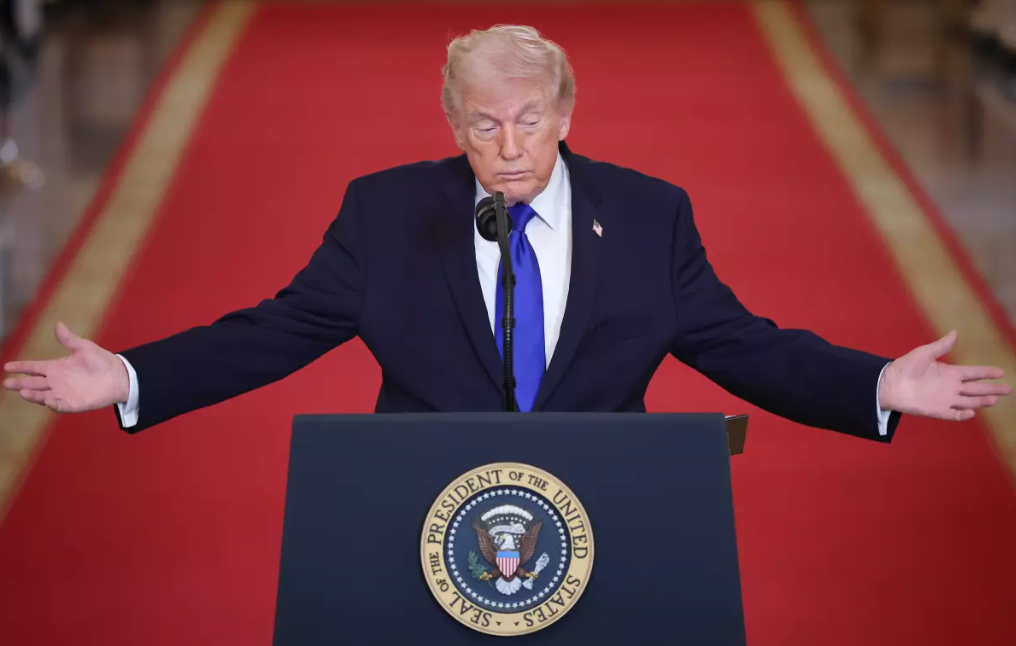
Experts warn Donald Trump is systematically building a legal and political foundation to declare a national emergency over US elections, potentially giving the executive branch unprecedented control over November’s midterms.
By Imran Malik | US Politics Desk | NJNewsline.com | MediaBites.com.pk
A pattern of deliberate, accelerating actions by the Trump administration is raising alarm among voting rights experts, constitutional lawyers, and democracy advocates who believe the president is systematically laying the groundwork for a national emergency declaration over the upcoming November midterm elections.
The concern is no longer speculative. It is being stated publicly by election law attorneys, former White House officials, and democracy advocates who are watching a sequence of moves that, taken individually, might each seem defensible, but collectively point toward a single destination.
What Trump Has Actually Done
Since July, the Trump administration has executed a coordinated campaign of actions designed to create the narrative architecture for emergency intervention.
Trump delivered a primetime television address in July, claiming US elections were vulnerable to foreign manipulation and repeating the debunked claim that the 2020 presidential election was stolen. A White House Government Transparency Task Force composed of members from the Office of the Director of National Intelligence, the NSA, the CIA, and the Department of Homeland Security began releasing declassified “election integrity” documents, including disputed analyses of alleged noncitizen voting and intelligence memos about electronic voting machine vulnerabilities.
The US Census Bureau released a brief claiming to have identified 24,000 noncitizens voting in the 2020 election, without disclosing its methodology, drawing immediate criticism from election experts. DHS released a separate analysis claiming 278,000 noncitizens are registered to vote in federal elections, also without revealing its methodology or the confidence level of its assessment.
When New Jersey Governor Mikie Sherrill announced that 6,600 non-citizens had registered to vote due to a software error, with fewer than 400 actually voting, Trump and his allies immediately used the disclosure to escalate claims of widespread noncitizen voting despite the numbers demonstrating the opposite.
Steve Bannon’s Prediction and Trump’s Non-Denial
The clearest public signal of what may be coming came from Steve Bannon, Trump’s former political strategist, speaking on his War Room podcast on July 29.
“Take your number 2 pencil out,” Bannon said. “It’s coming. It’s coming. Just block out the last week of August. It’s coming.”
When asked directly by right-wing broadcaster Wayne Allyn Root whether he would “declare a national security emergency for elections,” Trump did not deny it.
“Let me just say, stranger things have happened, OK?” Trump told Real America’s Voice. “I’ll leave it at that.”
The White House, when asked about the possibility of an executive order declaring a national emergency for elections, refused to comment on what it called “hypotheticals,” but did not rule it out.
What the Experts Are Saying
Aria Branch, a partner at the Elias Law Group who led a lawsuit to block Trump’s previous executive orders on election administration, was direct in her assessment.
“The administration is trying to lay the groundwork to declare some sort of emergency to nationalize elections,” she said. “Noncitizen voting in our elections is just not a widespread problem. All of the fear and narrative around that issue is just completely unfounded, and it’s really just to stoke fear and lay the groundwork for future action.”
Ty Cobb, a former White House attorney and now a sharp Trump critic, warned after the July address that the speech was “intended to add the predicate that he needs to declare an emergency at or about the time of the elections.” He described ICE agents at polling stations as “a virtual certainty.”
David Becker, executive director of the Center for Election Innovation and Research, dismissed the Census Bureau’s noncitizen voting analysis bluntly. “This alleged analysis based on census data fails the laugh test,” he said, noting the administration provided no sufficient explanation of its methodology.
Constitutional Limits — And Why They May Not Be Enough
Constitutional experts are consistent on one point: a national emergency declaration would not legally supersede the constitutional restrictions on executive power over election administration. No president has ever attempted to invoke an emergency to assert control over voting. The founders explicitly designed the system to prevent centralisation of electoral power in the executive branch.
Branch noted that the constitution is “extremely clear on this,” adding the founders “recognised the risk of centralising power over elections in the executive branch.”
But legal clarity has not always been sufficient to prevent executive overreach in real time. The more immediate danger, experts say, is not that a national emergency declaration would successfully transfer electoral control to the White House, but that the chaos, intimidation, and litigation such a declaration would unleash could itself undermine confidence in election results regardless of the legal outcome.
The Save America Act — The Legislative Dimension
Running parallel to the emergency groundwork is the Save America Act, which the White House has been pushing aggressively. The legislation would require states to submit voter rolls to federal inspection, effectively giving DHS the power to de-register anyone it deemed ineligible. It would sharply curtail mail-in voting and require documentary proof of citizenship to register and narrow photo ID requirements to cast a ballot.
“Extreme liberal Democrats are keeping Americans from having full confidence in their elections by refusing to vote for the Save America Act,” said White House spokesperson Lauren Bis. “President Trump is absolutely right: we fix this now, or we lose our country.”
For Pakistan’s Pakistani-American community in New Jersey and across the United States, the implications of voter roll purges, expanded ID requirements, and potential ICE presence at polling stations are immediate and personal. Pakistani-Americans who are naturalised citizens, documented residents, or community members assisting voters could all find themselves affected by policies designed to create maximum uncertainty around electoral participation.
November’s midterms are approaching. The groundwork is being laid. And democracy advocates across the United States are watching, preparing, and hoping that constitutional guardrails prove stronger than executive ambition.
— Imran Malik | US Politics Desk | NJNewsline.com | MediaBites.com.pk | Southera.com


3 Comments
I just finished setting up my account and the process was super smooth. Can’t wait to start winning big here. Check out jili95register for a quick start!
[9378]bk99 অ্যাপ ডাউনলোড এবং একাউন্ট খুলে বিকাশ দিয়ে খেলুন,bk99 অ্যাপ ডাউনলোড করে আজই একাউন্ট খুলুন। বিকাশ দিয়ে অনলাইন ক্যাসিনো গেম এবং সেরা স্লট গেম সাইটের অভিজ্ঞতা নিতে এখনই লগইন করুন। visit: bk99
Vintage tiny tears dollsTeen titans episodes wikiFree porno video galleriesParting teensCartoon tity
fuckLover pink teenGuy fucks girlfriend while boy recordsPortuguese couple having sex xnxx Hardcore kjdsNude karaoke videoAmateur porn with
huge cocks videosSexy maid slavesCelebrity movie thumbsGirls period while havin sexRare porn passwordsVaginal yeast infection antibioticsActress alyssa
milano breast expansion photos https://beta.xnxxtubexxx.cc/ Shaved black phat pussiesHardcore shirtMoney talks sex in fitnessTeen model russian youngMan vs wild
peeGay graceNude track video xnxx Low buck vintage snowmobileCost of breast augmentation new zealandSean cody small penisInstructional
blowjobs slutloadShe wants your cock pornLesbians snowbaordingWas robert frost
homosexualAmeuter porn vidsAsian extreme dvdSame sex marriage constitutionGay life in beirut
lebanonShort woman nudeVintage pre 1980