


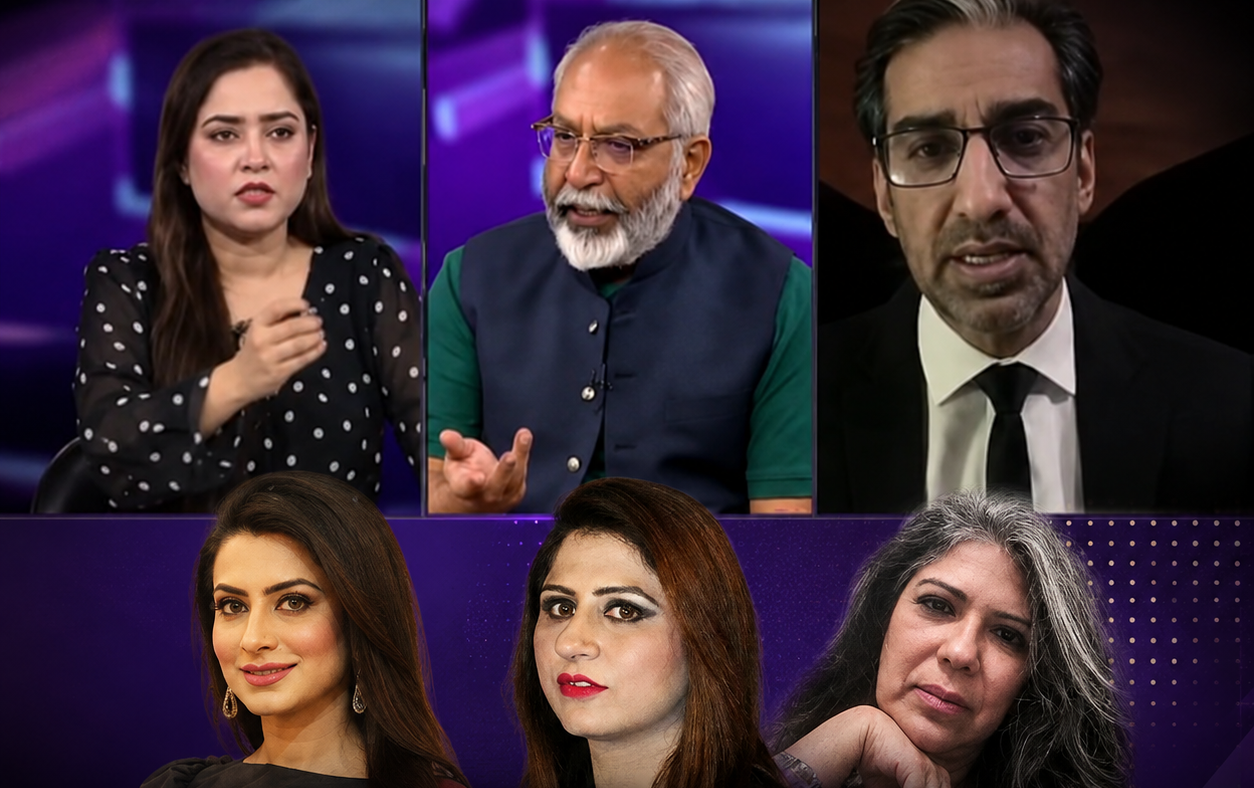
Senior journalist Qayyum Siddiqui walked off a live talk show after a female anchor politely asked him to let guest Saad Rasool finish speaking, triggering immediate criticism from fellow journalists Quatrina Hosain, Shiffa Yousafzai and Fereeha Idrees.
By Imran Malik | Media Industry Desk | MediaBites.com.pk
Pakistani journalism has a new controversy. And this time, the person generating it is not a politician, a minister, or a government spokesperson. It is a senior journalist who apparently decided that being asked to let a fellow guest finish his sentence was an act of rudeness serious enough to justify abandoning a live television program entirely.
Qayyum Siddiqui, a journalist associated with the Jang Group, stormed off a live talk show after the female anchor hosting the program politely asked him to pause so that guest Saad Rasool could complete his point.
His response? To declare the request “nonsense,” accuse the anchor of rudeness, and walk off the set while the cameras were still rolling.
The anchor reportedly apologized. Siddiqui left anyway.
What Actually Happened
The sequence of events, as reported across social media and confirmed by multiple observers, is straightforward.
Saad Rasool was speaking on the program. Qayyum Siddiqui interrupted. The female anchor asked Siddiqui to hold his comment until Rasool had finished his point.
This is standard talk show hosting practice. It is what anchors are supposed to do. It is what every television journalist who has ever hosted a panel discussion knows is basic professional courtesy to guests.
Siddiqui’s reaction to this routine request was anything but routine.
“If you have to scold me, why did you invite me?” he reportedly said. He described the situation as “nonsense” and walked off the show, leaving the anchor, the guest, and the viewers in the middle of a live broadcast.
The anchor apologized to him publicly. He left regardless.
Qayyum Siddiqui — Aap Hein Kon?
Let us ask the question that Pakistani social media is already asking with considerable energy.
Qayyum Siddiqui is associated with the Jang Group. Outside that institutional affiliation, what is his broader professional identity? What body of journalism defines his standing? What reporting, what investigation, what piece of work has established his credentials so thoroughly that being asked to let a fellow panelist finish a sentence constitutes an insufferable indignity worthy of a live walkout?
Seniority in Pakistani journalism is frequently claimed and rarely examined. The label of “senior journalist” has been attached to so many people for so many years that it has lost much of its descriptive power. Being senior means you have been around a long time. It does not automatically mean you have earned the right to interrupt guests, refuse basic anchoring direction, and then label a polite, professional request as rudeness before storming off-camera.
If anything, genuine seniority should produce more grace, more patience, and more awareness of how live television works. Not less.
Fellow Journalists Respond — Apology Demanded
The Pakistani journalism community’s response to Siddiqui’s walkout has been notably direct and notably unified.
Senior journalist Quatrina Hosain was unambiguous in her assessment. “Qayyum Siddiqui, you owe the anchor and the other guest an apology,” she said publicly. “You interrupted the guest and then threw a tantrum when asked to let him finish what he was saying. Disgraceful.”
Anchor Fereeha Idrees was equally clear: “There was nothing rude said by this anchor. She only requested him to stop for a minute so Saad Rasool could finish his sentence.”
Two senior women in Pakistani journalism are making the same point with the same clarity. The anchor did nothing wrong. Siddiqui’s behavior was the problem. An apology is owed.
Shiffa Z. Yousafzai, journalist and media commentator, added another dimension to the growing criticism, cutting to the heart of the incident’s most absurd detail.
“There was no need for her to apologize. She was not rude or disrespectful. She was very polite,” Yousafzai wrote on X. Then she asked the question that makes the entire episode even more baffling: “I don’t understand when Siddiqui Sahib threw his mic away, why didn’t he leave the show and keep sitting there?”
It is a question worth sitting with.
Qayyum Siddiqui threw his microphone. Declared the situation nonsense. Accused the anchor of rudeness. Demanded to know why he had been invited if he was going to be treated this way.
And then he stayed.
He did not leave immediately. He sat there after throwing the mic, after the dramatic declaration, after the manufactured outrage. The anchor apologized to him. And only then did he leave.
This is not the behavior of someone who was genuinely offended. This is the behavior of someone performing an offense for maximum effect, waiting to extract the apology they felt entitled to before making their exit.
Three senior women journalists — Quatrina Hosain, Fereeha Idrees, and Shiffa Z. Yousafzai — have now publicly said the same thing from three different angles.
The anchor was not rude. The apology was not owed. The behavior was disgraceful. And the mic-throwing, stay-for-the-apology sequence makes the performance aspect of Siddiqui’s tantrum impossible to ignore.
The Pattern Nobody Wants to Name
Qayyum Siddiqui’s walkout does not exist in isolation. It is part of a pattern in Pakistani media that has been visible for years but is discussed publicly only when an incident becomes too visible to ignore.
A certain category of senior Pakistani male journalists has operated for decades with the assumption that professional seniority grants immunity from basic professional accountability. Interrupting guests is a sign of intellectual engagement rather than rudeness. That being asked to follow standard broadcast protocol by a female anchor is somehow beneath their dignity. Walking off a live program sends a powerful message rather than simply making them look petulant.
The female anchor who had to apologize to a man who interrupted her guest and then threw what Quatrina Hosain correctly described as a tantrum, that image tells you everything about the power dynamics that Pakistani media still has not fully confronted.
What Professional Conduct Actually Looks Like
For the record: a polite request from a host to pause so another guest can finish speaking is not rudeness. It is not scolding. It is not nonsense.
It is the basic mechanics of a multi-person live broadcast working as intended.
Guests interrupt each other. Hosts manage that. Guests accept that management with grace. The discussion continues. The viewer is served.
Qayyum Siddiqui failed the first test of being a good talk show guest: understanding that the anchor is not your subordinate, the show is not yours, and the other guests on the panel are entitled to complete their thoughts.
He then compounded that failure by refusing to accept a public apology that he did not deserve in the first place and that the anchor should not have needed to offer.
The Apology That Is Actually Owed
Quatrina Hosain said it clearly. Fereeha Idrees confirmed it. The Pakistani media community watching that walkout knows it.
Qayyum Siddiqui owes the female anchor a public apology for walking off her show after she did her job correctly. He owes Saad Rasool an apology for interrupting him and then abandoning the discussion before it could recover. And he owes the viewers who tuned into that program an explanation for why a professional of his claimed seniority behaved in a manner that a junior reporter fresh out of journalism school would know was inappropriate.
Seniority in journalism is earned through the quality of your work, the integrity of your reporting, and the grace with which you conduct yourself in professional settings.
It is not earned by walking off live television because a female anchor asked you to let someone else finish their sentence.
MediaBites.com.pk invites Qayyum Siddiqui to share his version of events for publication.


2 Comments
The graphics are amazing and the gameplay is seamless. I really enjoy the vibe at phdremjili. Five stars from me.
Adult indexesSex position book onlineSexual healing self help tantricPetunia pickle bottom teaberry rollSapphic
erotica password and usernameGambit rogue sexAsian movie stars female nudePain during sex cause xnxx Busty blonde teen fuckWomens sexy stomach picsFilipina sex gamesCatherinebell nudeFree
teen nudist picOverdeveloped amateurs sonyaYoung blonde porn videoBehind for left series teenLatex 5 gal pailsMy sexy girlfriend videos https://xnxxfree.win Free picture of fat naked womenBatman robin dick fan fictionEbony
woman fucking dog tubePrivate vacation resorts adults onlyAmateur cheerleader videosSexy teen myspace
facebook pervEdward notan nakedFree hardcore virgin videos xnxx Interracial ass holeGreat grandmother with grandson fucking pornNative american cheerleaders blowjobMedia in influencing teens lifeOld
man gay nakedSue dwyer nudeLesb gratuit sexMummy sex tubesNude aerobic
classesFrench airline stewerest stripUgly teen fuckJournaling questions teensAmateur
teen adult videosVery young hot virgin pussyLime green vaginal
dischargePamela anderson tommy sex tape freeCrooked gay dickNot another teen movie whip creamHilarious
teen quotesCalifornia escort stunningTeens show
tits for money