


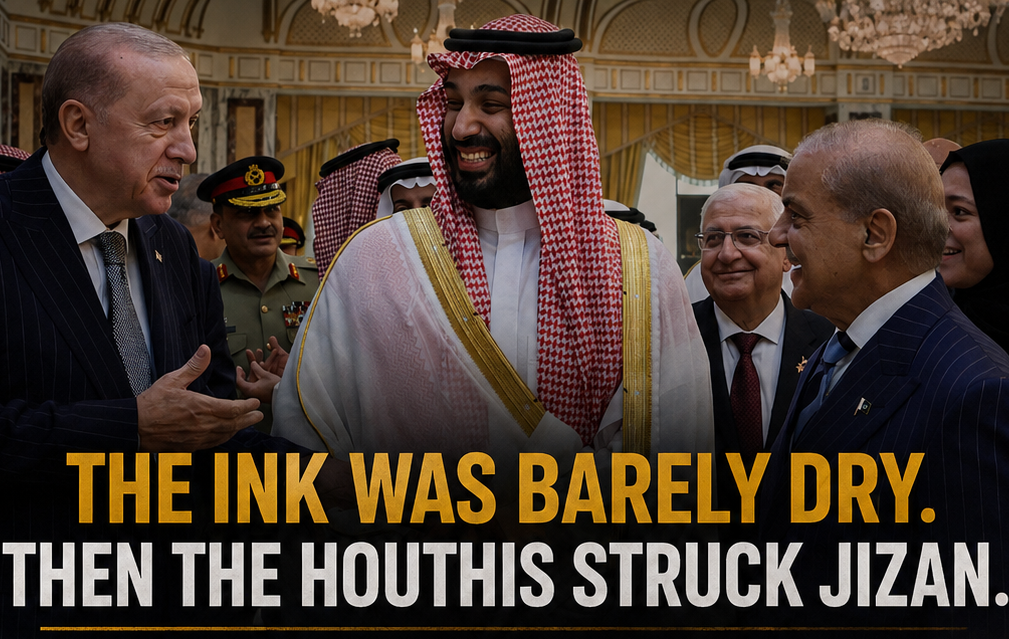
Saudi Arabia, Turkey and Pakistan signed a landmark NATO-style defence pact in Mecca binding all three against shared threats — hours before Iran-backed Houthis struck Saudi Aramco’s Jizan refinery with a precision drone.
WEBDESK | World Affairs & Security Desk | AFP
History rarely provides timing this dramatic.
Saudi Arabia, Turkey and Pakistan signed one of the most consequential defense agreements in recent Middle Eastern history — a NATO-style mutual defense pact in Mecca that considers any attack on one country as an attack on all three. Within hours of the signing, Iran-backed Houthi rebels struck Saudi Aramco’s Jizan oil refinery with a precision drone strike.
The juxtaposition could not be more pointed. Three powerful Sunni nations bind themselves together in a historic security architecture. And the very threat that drove them to the table immediately tests what that architecture means in practice.
What the Pact Actually Does
The Mecca-signed agreement binds three of the United States’ most significant Muslim-majority allies — Saudi Arabia, Turkey and Pakistan — in a collective security arrangement with a clause directly mirroring NATO’s Article 5: an attack on one is an attack on all.
Analysts describe the pact as serving three simultaneous strategic purposes. It deters an increasingly bellicose Iran. It sends a clear signal to Israel that regional security architecture will not be shaped around Israeli interests. And it hedges against an increasingly unreliable United States that has oscillated between deep engagement and strategic withdrawal across successive administrations.
“This pact sends a politically symbolic signal to Iran and Israel,” said H.A. Hellyer of the Royal United Services Institute.
Will Turkey and Pakistan Actually Fight Iran?
The honest answer from analysts is almost certainly no — at least not directly.
Asli Aydintasbas of the Brookings Institution was direct: “Turkey and Pakistan will not fight Iran. These countries view themselves as stabilizers and want to create political momentum to push for that.”
Pakistan has maintained active diplomatic channels with Iran throughout the Middle East conflict — with Field Marshal Asim Munir holding direct calls with Iranian Foreign Minister Abbas Araghchi as Pakistan positioned itself as a mediator between Tehran and Washington.
Turkey has similarly maintained its role as an honest broker. Both countries derive strategic value precisely from their ability to talk to all sides — a value that direct military confrontation with Iran would instantly eliminate.
The mutual defense clause is therefore more symbol than sword. But symbols in geopolitics carry real weight — and this one signals to Tehran that attacking Saudi Arabia has consequences that extend far beyond bilateral Saudi-Iranian relations.
The Houthi Strike — Instant Test of the New Alliance
The Houthi drone strike on Aramco’s Jizan refinery landed within hours of the pact’s signing — a timing that carries unmistakable strategic messaging from Iran’s proxy network.
Houthi military spokesman Yahya Saree confirmed that the group had “succeeded in targeting the Aramco refinery in Jizan with a drone, and the strike was precise” — describing it as retaliation for Saudi drone incursions into northwest Yemen.
Saudi Arabia’s energy ministry confirmed that civil response teams extinguished the fire at the Jizan facility without injuries. The same refinery had been targeted by Houthi rebels in July.
The strike demonstrates exactly why the Saudi-Turkey-Pakistan pact was necessary — and exactly why its mutual defense clause will be scrutinized so carefully in the coming weeks.
A New Regional Architecture — Without Israel
Perhaps the most geopolitically significant dimension of the new alliance is what it excludes.
The United States has long sought to build a regional security architecture that integrates Israel — building on the Abraham Accords and pushing for Saudi-Israeli normalization as the centerpiece of a Washington-led regional order.
The Mecca pact represents a direct alternative to that vision. Saudi Arabia has insisted it will not normalize relations with Israel unless a credible path to Palestinian statehood is established. Turkey and Pakistan have been among Israel’s most vocal critics throughout the Gaza and broader Middle East conflict.
“Washington would have wanted a security architecture that includes Israel,” Hellyer noted. “This alliance doesn’t point to that in the slightest.”
The pact, he said, “shows a desire to interrupt both the project of Iranian hegemony and that of Israeli paramountcy.”
For Pakistan, the alliance represents a significant diplomatic and strategic milestone — binding Islamabad formally into a Gulf security framework while preserving its mediating role. Pakistan sits at the intersection of every major regional tension: neighbor to Iran, strategic partner of Saudi Arabia, NATO-adjacent through Turkey, and nuclear power with credibility across the Muslim world.
The Houthis struck Jizan. The ink on the pact was barely dry. The new alliance’s first real test has already arrived.


1 Comment
[5736]ppp login করুন এবং বিকাশ দিয়ে অনলাইন স্লট গেম খেলুন,ppp login করুন এবং ppp app download করে লাইভ ক্যাসিনো বোনাস অফার বুঝে নিন। অনলাইন স্লট গেম ট্রিকস শিখে আজই খেলা শুরু করুন। visit: ppp