


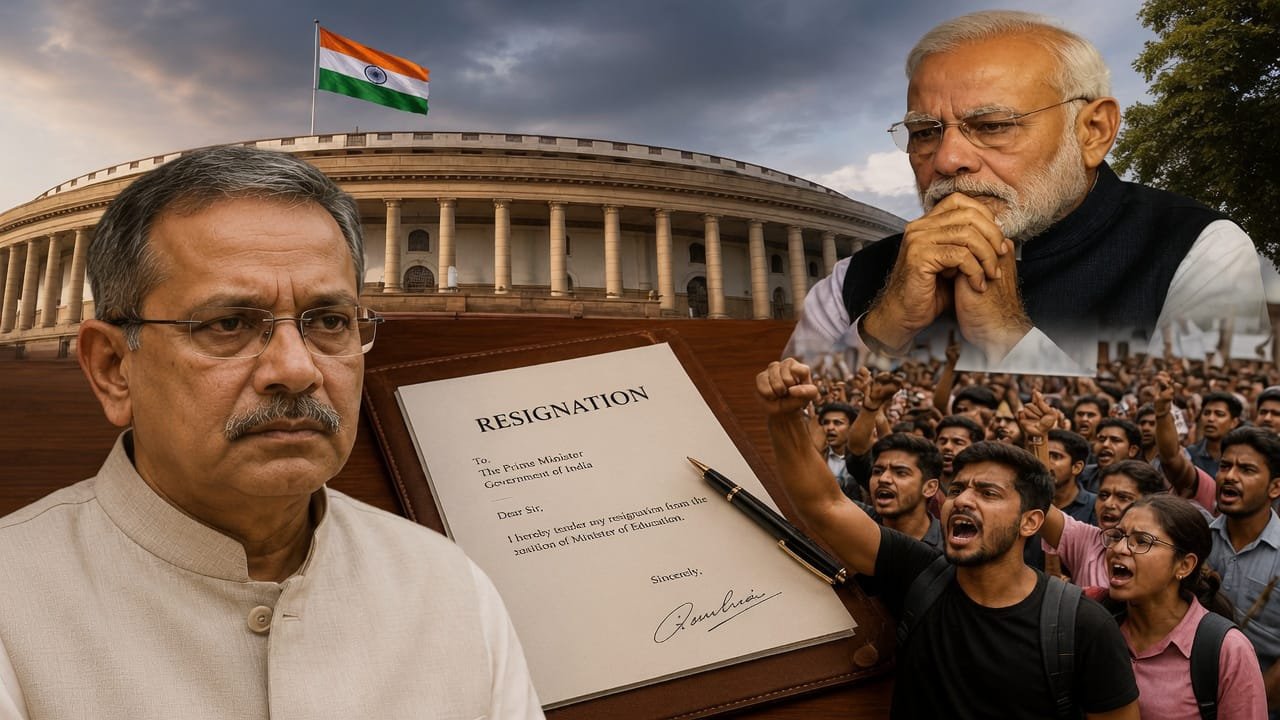
Indian Education Minister Dharmendra Pradhan resigns after weeks of youth protests over NEET paper leaks. Student-led Cockroach Janta Party claims victory in rare public pressure success.
WEBDESK – MADIHA BHATTI – MEDIABITES NEWS
Background of the Controversy
The resignation of Union Education Minister Dharmendra Pradhan on 25 July 2026 marks a rare instance of sustained public pressure forcing a senior minister out of Prime Minister Narendra Modi’s government.
The crisis began after alleged irregularities in the NEET-UG 2026 medical entrance examination held on 3 May 2026. Claims of paper leaks and procedural failures triggered widespread anger among students, who viewed the exam as a crucial gateway to medical education.
Authorities cancelled the original examination, ordered a CBI investigation, and conducted a re-examination. However, these steps failed to calm public frustration. Students and youth groups argued that accountability at the highest level was still missing and that deep flaws in India’s examination system remained unresolved.
Rise of the Protests
What started as online criticism soon turned into nationwide demonstrations.
The Cockroach Janta Party (CJP), a youth-driven movement formed after a controversial judicial remark comparing some unemployed young people to cockroaches, became one of the leading voices behind the protests.
Large gatherings were held at Jantar Mantar in New Delhi and several other cities. Protesters made one demand clear: Dharmendra Pradhan’s resignation.
The movement gained further momentum through hunger strikes, including a 26-day fast by social activist Sonam Wangchuk. Clashes between protesters and police, including the use of tear gas, intensified public anger.
As opposition parties joined the campaign, the controversy evolved from an education issue into a major political challenge for the Modi government.
The Minister’s Decision
On 25 July 2026, Dharmendra Pradhan announced on social media platform X that he had submitted his resignation to Prime Minister Narendra Modi.
In his statement, he reflected on more than four decades of involvement in education and reform. He highlighted the government’s response after the irregularities surfaced, including transferring the investigation to the CBI, cancelling the compromised examination, conducting a re-test, and deciding to move future NEET examinations to a computer-based format.
Pradhan said the controversy had caused him deep anguish. He stressed that his resignation was not about personal prestige but about preventing youth unrest from being exploited by what he described as anti-national forces, preserving national unity, and allowing students to refocus on their education and careers.
He also thanked the Prime Minister for his guidance and support.
Government Response and Legislative Action
Alongside the resignation, the government moved to strengthen laws against examination malpractice.
The Union Cabinet approved a draft bill proposing stricter punishment for paper leaks and related offences. The proposed legislation includes prison terms of up to 10 years and fines of up to ₹10 crore. It seeks to amend the existing Public Examinations (Prevention of Unfair Means) Act.
The government had also announced fast-track courts for examination-related cases.
These measures reflect an effort to address public concerns while limiting the political fallout. Talks between CJP representatives and government officials continued in the days before the resignation, with protesters insisting that a leadership change was essential.
Student Reactions and Public Sentiment
Students across major coaching hubs, including Kota, Delhi, and Hyderabad, described the resignation as a long-overdue acknowledgment of their concerns.
Social media was flooded with reactions ranging from cautious relief to renewed demands for deeper reforms.
Parents and teachers pointed out that years of preparation and significant financial sacrifices had been jeopardized by repeated examination failures.
While many viewed the resignation as proof that peaceful public pressure can bring accountability, others argued that genuine reform would only be evident if future examinations are conducted without leaks or irregularities.
What Lies Ahead for the Education Ministry
Attention has now shifted to the appointment of Pradhan’s successor and the progress of the proposed anti-paper leak legislation in Parliament.
Officials have indicated that the transition to fully computer-based NEET examinations will be accelerated. Additional security measures and greater transparency in the examination and result process are also expected.
Whether these reforms restore students’ confidence will determine if this episode becomes a lasting turning point or merely another chapter in India’s recurring examination controversies.
Why the Resignation Matters
Pradhan’s resignation is widely viewed as the first major concession extracted from the Modi government through sustained public protests since 2014.
Student and youth organizations celebrated the development as a democratic victory, while CJP leaders claimed that persistent public mobilization had forced accountability.
The controversy also exposed deeper structural weaknesses in India’s competitive examination system. Repeated paper leak incidents have undermined trust among millions of aspirants who invest years of preparation and substantial financial resources in these exams.
The government’s decision to introduce computer-based testing and tougher anti-cheating laws signals growing recognition that meaningful administrative and technological reforms are overdue.
Broader Implications
The protests ultimately grew beyond a single examination controversy.
They sparked a wider national debate about youth aspirations, unemployment, and the government’s responsiveness to public concerns.
The participation of students, professionals, parents, and families across multiple states demonstrated how shared frustration over examination failures can unite diverse groups around a common cause.
For the government, the resignation removes a major source of public anger while testing its ability to restore trust through reforms.
For the opposition, it offers a notable example of successful pressure politics.
For students, the resignation represents symbolic accountability. However, lasting confidence will depend on whether future examinations are conducted fairly, securely, and transparently.
The coming weeks will reveal who succeeds Dharmendra Pradhan and how quickly the proposed anti-paper leak legislation progresses through Parliament. More importantly, they will show whether the promised reforms can rebuild trust in India’s competitive examination system.


1 Comment
我之前都是用別的外掛,但最近常失靈,換成這個 M3U8 下載擴充功能 後穩定很多,真的相見恨晚。