


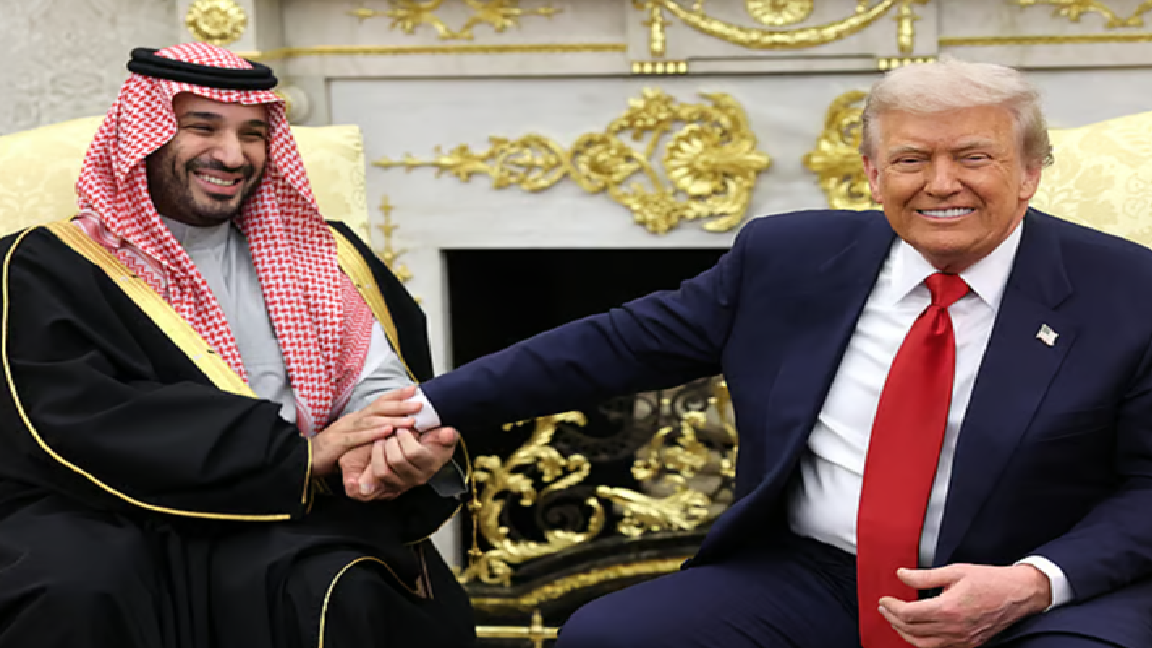
President Donald Trump says a proposed US-Saudi civilian nuclear deal depends on Saudi Arabia recognizing Israel through the Abraham Accords, adding fresh complexity to Middle East diplomacy.
WEBDESK – MEDIABITES
US President Donald Trump has said a proposed civilian nuclear agreement with Saudi Arabia will only move forward if Riyadh agrees to normalize diplomatic relations with Israel under the Abraham Accords, linking two of the most significant geopolitical initiatives in the Middle East.
In a social media post on Thursday, Trump said the proposed agreement would be approved only if Saudi Arabia joins the Abraham Accords, the US-brokered framework launched during his first presidency that established diplomatic ties between Israel and several Arab nations.
“The agreement will be approved, but is totally subject to Saudi Arabia joining the very respected and successful Abraham Accords,” Trump wrote. He also stressed that the proposed cooperation would support only civilian nuclear facilities and would not permit uranium enrichment.
The statement marked the clearest indication yet that the Trump administration intends to make diplomatic recognition of Israel a key condition for long-term nuclear cooperation with the Gulf kingdom.
Saudi Arabia, however, has consistently maintained that any normalization with Israel depends on establishing a credible path towards an independent Palestinian state. That position remains at odds with Israeli Prime Minister Benjamin Netanyahu, who has repeatedly rejected Palestinian statehood on security grounds.
The Saudi Embassy in Washington declined to comment on Trump’s remarks. Netanyahu’s office welcomed the possibility of Saudi Arabia joining the Abraham Accords, calling it a “historic leap forward for peace in the Middle East,” but did not directly address the nuclear agreement.
The proposed US-Saudi nuclear cooperation agreement, announced earlier this week, is expected to remain in force for 30 years and would allow American companies to help develop Saudi Arabia’s civilian nuclear energy program. The deal will be submitted to the US Congress for review.
Trump’s latest comments also appeared to clarify uncertainty surrounding uranium enrichment. While earlier reports suggested Saudi Arabia could eventually study domestic enrichment under US supervision, Trump insisted the agreement would not allow uranium enrichment, seeking to address concerns raised by nuclear non-proliferation experts.
Critics argue the agreement lacks sufficient safeguards, including the International Atomic Energy Agency’s Additional Protocol, which provides stronger inspection and verification measures for civilian nuclear programs.
US Secretary of State Marco Rubio defended the agreement, saying it would ensure Saudi Arabia partners with American companies instead of turning to competitors such as China, Russia, France or South Korea for nuclear technology.
“We’re not the only show in town, but we’re the best show in town,” Rubio told reporters during a visit to Manila.
The proposal has already drawn scrutiny in Washington, with both Republican and Democratic lawmakers questioning whether Congress should have greater oversight of any nuclear cooperation with Saudi Arabia. Some US lawmakers have also argued that stronger non-proliferation safeguards should be included before the agreement receives approval.
For Pakistan, developments surrounding the US-Saudi nuclear partnership will be closely watched, given Riyadh’s strategic role in the Muslim world and the broader implications for regional security, energy cooperation and shifting alliances in the Middle East. The future of the agreement may ultimately depend not only on Congressional approval but also on whether Saudi Arabia is prepared to take the politically sensitive step of recognizing Israel.
Sources: AP (preferred), Gulf News.


7 Comments
References:
Winningz Casino Bewertung fr.chaturbate.com
References:
Mega Medusa Casino Test https://login.fagbokforlaget.no/Registration/Pin?returnUrl=https://smartcard.phoenixopia.com/vitoalfaro7442
References:
Cryptologic Casino Auszahlung https://aktsh.ru/
References:
Cosmo Casino App inlinehokej.sh10w2.esports.cz
References:
Lex Casino Bewertung http://users.atw.hu
References:
Odds calc 1gocasinotest.onlinespielhallende.workers.dev
References:
Rolletto Casino Erfahrungen locuss.evomeet.es