


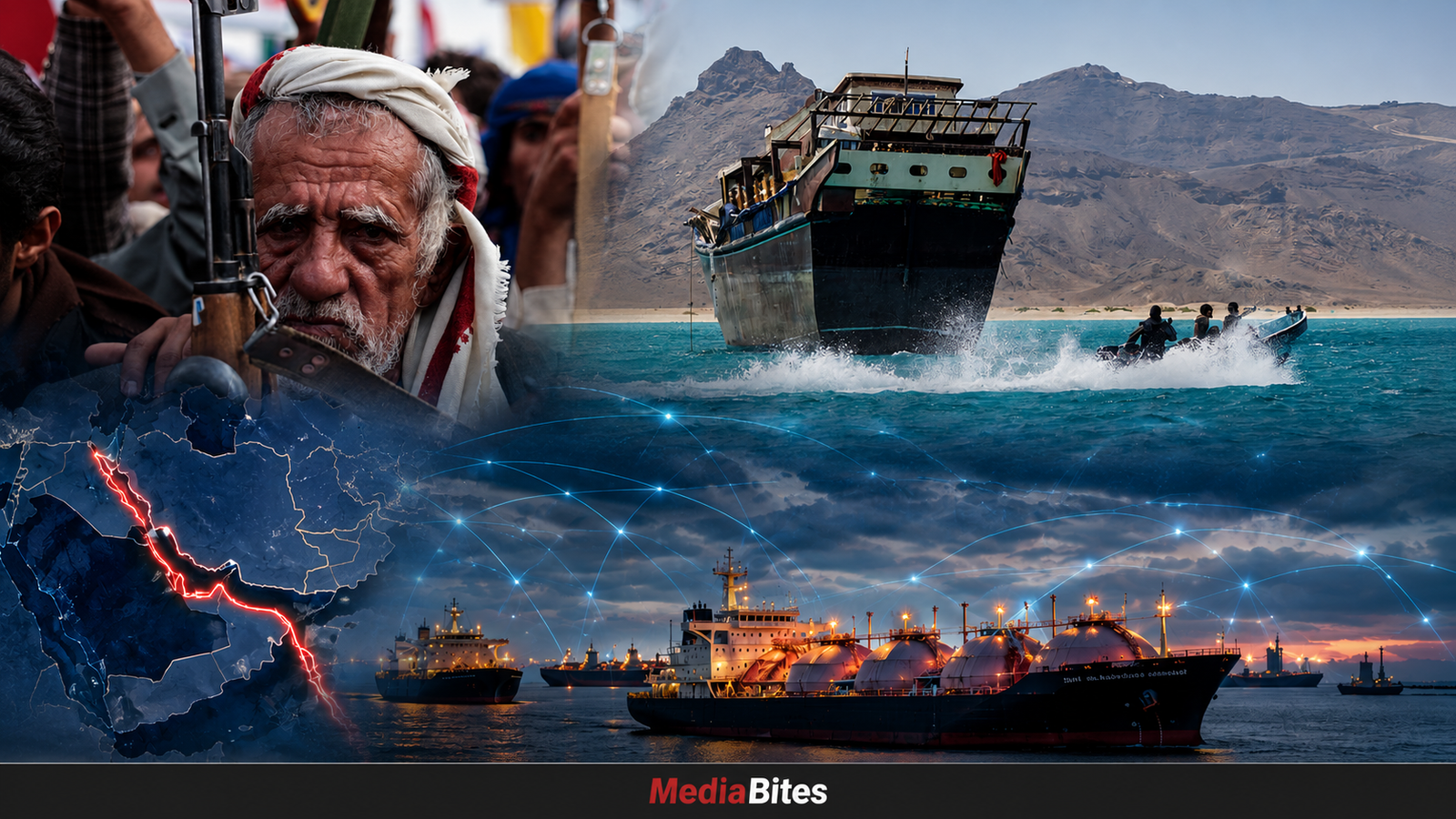
Houthi threats to block Saudi shipping through Bab Al-Mandab have drawn global condemnation, raised oil price risks, and put Pakistan’s deep defence partnership with Saudi Arabia directly in focus.
Lead by Arab News | Imran Malik | MediaBites.com.pk
Four Saudi crude tankers turned back from their routes on Tuesday after Yemen’s Houthi militia issued one of its most audacious threats yet — warning that any vessel calling at Saudi ports could be targeted anywhere within their operational reach. The declaration, made a day after the group announced a maritime blockade against Saudi Arabia, has sent alarm bells ringing across global shipping markets, Gulf capitals, and Washington.
Experts are now saying the Houthis have made a serious strategic miscalculation. And the consequences of that miscalculation will be felt far beyond the Red Sea.
What the Houthis have done — and why it is different this time
During the Gaza war, Houthi attacks on Red Sea shipping carried a narrow justification, targeting vessels they claimed were linked to Israel or the United States in solidarity with Palestinians. That framing gave them a degree of political cover in some quarters, even as the United Nations Security Council unanimously condemned their strikes.
The latest escalation abandons that cover entirely. By explicitly threatening any vessel trading with Saudi ports, the Houthis have moved from presenting themselves as a resistance movement to acting as an instrument of economic coercion against one of the Arab world’s most important economies.
Mohammed Al-Basha, founder of US-based risk consultancy Basha Report, captured the shift precisely. “They have shifted from presenting themselves as an oppressed movement to acting in ways that many now see as oppressive,” he told Arab News. “Their actions have strengthened the arguments of those who support a military solution to the Houthi issue in Yemen.”
The strategic geography — why Bab Al-Mandab matters to the world
The Bab Al-Mandab Strait connects the Indian Ocean to the Mediterranean via the Suez Canal, carrying approximately 7% of global maritime traffic. Combined with the Strait of Hormuz, more than 25% of the world’s oil and gas shipments pass through these two chokepoints.
Saudi Arabia has already invested heavily in its East-West pipeline to reduce exposure to Hormuz risk following that strait’s partial closure. The Red Sea route is now Riyadh’s primary energy export lifeline. A credible Houthi threat to that route is therefore not simply a security problem. It is an existential economic threat to Saudi Arabia’s Vision 2030 transformation strategy.
The Saudi-led coalition has condemned the blockade as a blatant violation of international law and maritime piracy, vowing a firm response and deploying protection measures for Saudi-linked vessels transiting the strait.
Military realities the Houthis are underestimating
Former senior CIA intelligence officer Norman Roule, who spent 34 years managing Middle East intelligence programs including as US national intelligence manager for Iran, told Arab News that Houthi rhetoric should be taken seriously, but so should the military realities they face.
“The US continues to maintain a robust naval force in the region, which is more than capable of working with Saudi partners to ensure the stability and frequent navigation in the Red Sea,” Roule said. European naval forces under Operation Aspides are also present, with additional mine-sweeping capacity deployed in the Red Sea.
Saudi military capabilities have changed markedly since the Yemen war began. Nawaf Obaid of King’s College London has described the Saudi-led Joint Forces Command as having reached military maturity with more than 650,000 personnel built around intelligence, precision strikes, air defense, and cyber operations.
The Houthis must weigh, as Roule put it, Saudi-American military forces that would be “quite devastating,” plus potential Israeli action given Israel’s previous damaging strikes against Houthi positions.
Pakistan’s response and its defense partnership with Saudi Arabia
Pakistan has a deep, multidimensional defense relationship with Saudi Arabia, making this crisis directly relevant to Islamabad’s foreign policy calculations.
Pakistan and Saudi Arabia have maintained one of the most significant bilateral defense partnerships in the Muslim world for decades. Pakistan has provided military training, advisory support, and personnel to Saudi Arabia’s armed forces. The two countries share defense cooperation agreements covering training, equipment, and strategic consultation.
Pakistan has previously expressed solidarity with Saudi Arabia on Yemen-related security matters and has consistently supported the Kingdom’s right to defend its sovereignty and territorial integrity. Islamabad has also been careful to avoid direct military involvement in the Yemen conflict while maintaining its strategic relationship with Riyadh.
The Houthi maritime blockade targeting Saudi trade directly threatens Pakistan’s own economic interests. Pakistan’s trade with Saudi Arabia, remittances from approximately 2.5 million Pakistani workers in the Kingdom, and Pakistan’s dependence on Saudi oil imports all pass through or depend upon stable Red Sea and Gulf shipping routes.
Any significant disruption to Saudi Arabia’s Red Sea exports would affect global oil prices, directly impacting Pakistan’s already strained import bill and fuel costs for Pakistani consumers.
Is a military solution coming?
The diplomatic temperature has risen sharply. The UAE, GCC Secretary-General, Kuwait, Qatar, and the United Nations have all condemned the Houthi blockade declaration. The breadth of condemnation signals the Houthis’ growing isolation on this specific escalation.
Saudi Arabia has so far maintained a restrained diplomatic posture. But experts warn that patience is wearing thin. Each Houthi provocation increases the probability of a Saudi response targeting not just missile launchers and drones but the wider command-and-control and logistics networks behind Houthi operations, potentially pulling Riyadh and Tehran closer to direct confrontation.
As Roule noted, Washington understands that Iran has continued enabling the Houthis. That understanding makes the current moment, with Western naval forces deployed and regional backing for Riyadh consolidating, genuinely different from earlier phases of the Yemen conflict.
The Houthis have miscalculated the resolve arrayed against them. The question is how long before that miscalculation produces consequences they cannot reverse.

