


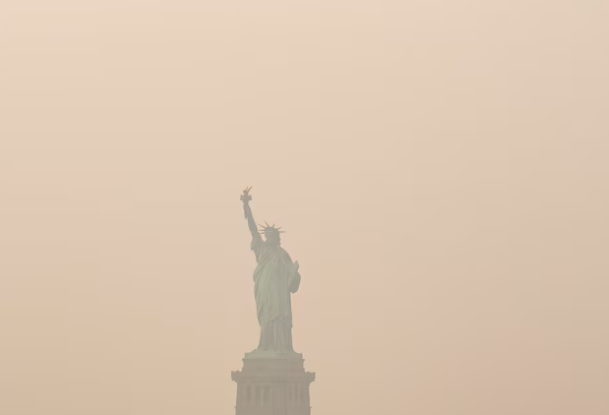
Smoke from hundreds of Canadian wildfires blanketed major US cities, prompting health warnings, mask recommendations, and fresh concerns about climate change and worsening air pollution.
WEBDESK – MEDIABITES
A massive plume of smoke from hundreds of wildfires burning across Canada has spread deep into the United States, blanketing major cities from the Midwest to the Northeast and prompting authorities to urge millions of residents to stay indoors as air quality reached hazardous levels.
The smoke, driven south by shifting weather patterns, has affected communities across the Great Lakes region and parts of the East Coast, creating dangerous air pollution and reducing visibility in several metropolitan areas. Officials warned that prolonged exposure could pose serious health risks, particularly for children, older adults, and people with respiratory or heart conditions.
Detroit recorded the world’s worst air quality on Thursday, according to air monitoring company IQAir. The city registered a pollution index of 600—double the level classified as “hazardous” by the U.S. Environmental Protection Agency—making outdoor activity unsafe for residents.
Federal monitoring data also showed dangerous smoke concentrations across Minnesota, Michigan, northern Illinois, northern Ohio, and parts of Ontario, Canada. Major cities, including Minneapolis, Milwaukee, and Toronto, experienced hazardous air quality, while at least 10 U.S. states reported locations with “unhealthy” pollution levels stretching from Minnesota to Maryland.
The smoky conditions reached New York City, where an orange-yellow haze covered the skyline and dramatically reduced visibility. The Statue of Liberty was barely visible as thick smoke drifted across the harbor.
New York City Mayor Zohran Mamdani warned residents that Thursday was expected to be the worst day of the smoke event and urged everyone—not only vulnerable groups—to take precautions.
“At ‘unhealthy’ levels, everyone may experience health effects,” the mayor said while announcing that the city would distribute free KN95 face masks through libraries, police precincts, and fire stations.
Residents described the effects of the polluted air as immediately noticeable. Gwen Moseley, a therapist from Queens, said she picked up a free mask before heading to work.
“Who wants to be breathing this? It’s not healthy,” she said, adding that she could already feel irritation in her throat while walking outdoors.
In downtown Chicago, 76-year-old Bill Ostrowski also wore a protective mask as thick smoke obscured the city’s skyscrapers.
“It stinks. It’s not a good sign when you wake up in the morning, and you can smell the air,” he said.
The smoke is being fueled by one of Canada’s most severe wildfire seasons in recent years. As of Thursday morning, authorities reported 858 active wildfires across the country, including 111 classified as out of control. The largest blazes are concentrated in the provinces of Manitoba, Saskatchewan, and Ontario.
Atmospheric scientists say the current smoke event demonstrates how increasingly intense wildfire seasons are affecting communities far beyond the fire zones themselves.
“It’s basically a river of smoke pouring into the Midwest right now,” said Emily Fischer, an atmospheric chemist and professor at Colorado State University.
She added that the event illustrates the growing influence of climate change on wildfire intensity and air quality.
The widespread smoke has renewed concerns about the long-term health impacts of wildfire pollution, which can travel thousands of kilometers and expose millions of people to harmful fine particulate matter. Health officials continue to advise residents in affected areas to limit outdoor activities, keep windows closed, use air filtration where possible and wear high-quality masks if they must go outside.


16 Comments
References:
Lollybet Casino Zahlungsmethoden http://www.nwnights.ru/redirect/lollybet.com.de
References:
Lollybet Casino Einzahlung https://www.ntis.gov/external_link_landing_page.xhtml?url=https://lollybet.com.de
References:
Lex Casino Test https://s3.amazonaws.com/
References:
%random_anchor_text% https://talenthubsol.com/companies/sofort-spielen-bonus-sichern
References:
Nv Casino Test milegajob.com
References:
Candy96 free spins winesandjobs.com
References:
Stratosphere Casino Einzahlung images.google.hn
References:
Candy 96 Australia realestate.kctech.com.np
References:
Snatch Casino Bewertung http://cse.google.sh
References:
777 Casino App m.animal.memozee.com
References:
Nv1 Casino App http://hufschlag-foto.de/gallery2/main.php?g2_view=core.UserAdmin&g2_subView=core.UserLogin&g2_return=https://vcardgrow.in/chasityfrick3
References:
Bet365 Casino Einzahlung users.fmf.uni-lj.si
References:
Sg Casino Bonus https://board-de.drakensang.com
References:
Vulcan Casino Bonus https://longlive.com/node/65989
References:
Nodepositbonus cc https://1gocasinotest.onlinespielhallende.workers.dev
References:
Luck Casino Erfahrungen dynamicviewpoint.co.uk