


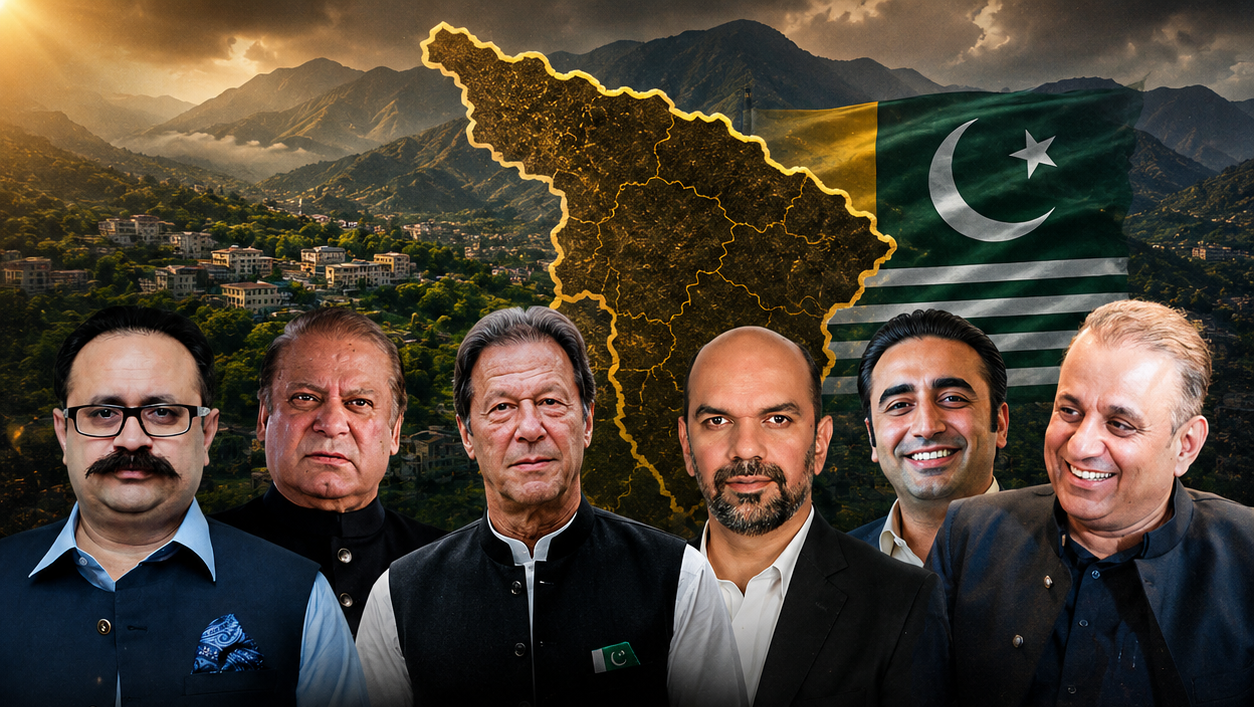
Azad Jammu and Kashmir (AJK) goes to polls on July 27 with PTI’s boycott, JAAC protests, refugee seat controversy, and a fierce four-party contest reshaping the political landscape of Pakistan’s most sensitive territory.
By Imran Malik | National Affairs Desk | MediaBites.com.pk
On July 27, 2026, Azad Jammu and Kashmir will hold its most consequential general election in recent memory. The backdrop could not be more turbulent. Protests have shaken the region. A major political party has announced a boycott. Armed clashes have claimed lives. And the fate of 12 refugee seats hangs over the entire process like an unresolved constitutional cloud.
The AJK Election Commission confirmed polling across all constituencies from 8 AM to 5 PM on July 27, with 3,804,385 registered voters across 45 constituencies, an increase of 583,839 voters since the 2021 elections.
This is not just a regional election. It is a referendum on stability, representation, democracy, and the meaning of Kashmiri political identity in 2026.
Why These Elections Matter
AJK occupies a unique constitutional position in Pakistan — neither a full province nor a separate nation, but a territory whose political direction carries enormous symbolic and strategic weight for the Kashmir cause internationally.
In the 2021 elections, PTI won 32 seats, PPP won 12, and PML-N won 7, with PTI comfortably forming a majority government with 32 out of 53 seats and electing Abdul Qayyum Khan Niazi as Prime Minister.
The PTI government collapsed dramatically. Less than a year later, following a vote of no confidence by 25 members of his own party, Niazi resigned. His replacement, Tanveer Ilyas Khan, was subsequently disqualified by the High Court after being found guilty of contempt of court. Speaker Chaudhry Anwarul Haq then assumed the Prime Ministership, created a 12-member forward bloc of PTI members, and formed a coalition with the PPP and the PML-N.
The political instability of the past five years makes the 2026 election a genuine reset moment for AJK’s governance.
The Election Schedule — Key Dates
The revised election schedule confirmed that the final candidate list was published on July 4, election symbols were allotted on July 5, and polling will take place on July 27.
The AJK Legislative Assembly comprises 33 constituencies within AJK itself and 12 constituencies reserved for refugees from occupied Jammu and Kashmir based in Pakistan, with 438,546 voters registered in those 12 refugee constituencies.
Parties Participating — The Main Contest
Pakistan Muslim League-N (PML-N)
PML-N released its final candidate list for 37 constituencies on June 18, 2026, with nominations approved by party president Nawaz Sharif, covering constituencies across Mirpur, Bhimber, Kotli, Bagh, Poonch, Muzaffarabad, Neelum, Haveli, and Jammu divisions.
PML-N enters these elections as part of the ruling coalition in Islamabad, giving it significant administrative and resource advantages. The party’s campaign is being overseen from Lahore with senior leader Saad Rafique chairing preparatory meetings. PML-N’s pitch rests on federal government support for AJK’s development and its role in maintaining stability after PTI’s turbulent tenure.
Pakistan Peoples Party (PPP)
PPP enters the 2026 election with genuine confidence. The party currently holds AJK’s premiership through Faisal Mumtaz Rathore, who assumed the office in November 2025, giving it an incumbency advantage.
Former Prime Minister Raja Pervez Ashraf, serving as the PPP’s central Punjab president, addressed a press conference expressing the party’s confidence in victory. He confirmed that PPP Chairman Bilawal Bhutto-Zardari would visit AJK ahead of polling day. Ashraf emphasized PPP’s deep historical connection with Kashmir, citing the longstanding commitment of Zulfikar Ali Bhutto, Benazir Bhutto, and President Asif Ali Zardari to the Kashmiri cause.
PPP’s campaign is grounded in its claim to be the authentic representative party of AJK’s people, independent of federal political fluctuations.
Istehkam-e-Pakistan Party (IPP) — Aleem Khan’s Vehicle
IPP announced candidates for 35 constituencies, with party President Aleem Khan personally distributing tickets. AJK IPP President Sardar Tanveer Ilyas will contest from three constituencies simultaneously — LA-15, LA-22, and LA-25.
IPP’s participation in AJK is its most serious electoral test since the party’s formation. Aleem Khan, who built his political reputation as one of PTI’s most capable organizers before the split, is betting that IPP can position itself as a credible third force in AJK just as it did in the Gilgit-Baltistan elections.
The Sardar Tanveer Ilyas Question
The involvement of Sardar Tanveer Ilyas Khan as IPP’s AJK president is one of the most debated aspects of this election.
Tanveer Ilyas brings significant name recognition to IPP in AJK. He served as AJK Prime Minister under PTI’s umbrella from April 2022 until his disqualification by the High Court in April 2023 for contempt of court. His tenure was controversial and ultimately legally terminated.
He was subsequently rejected by PPP when he sought political accommodation there. His induction into IPP raised eyebrows even within party circles. Critics argue that a figure associated with a failed, legally terminated premiership does not lend credibility to IPP’s brand. Supporters counter that his local name recognition and organizational network in AJK constituencies provide genuine vote-pulling capacity regardless of past controversies.
The honest assessment: Tanveer Ilyas is a calculated gamble by Aleem Khan. He adds local ground-level reach but carries substantial reputational baggage. Whether the votes he brings exceed the credibility cost he imposes on IPP’s image will be answered on July 27.
Is IPP a Genuine Third Force in AJK?
The Gilgit-Baltistan experience offers a cautiously encouraging precedent for IPP. In the GB elections, IPP, combined with aligned independent candidates, emerged as the third-largest political grouping. The formula was not a straightforward party victory but a strategic coalition of votes around a common political identity.
In AJK, the dynamics are more complex. PTI’s boycott removes a major competitor but does not automatically transfer PTI votes to IPP. AJK’s electorate has its own distinct political loyalties, shaped by local family networks, community affiliations, and regional issues, quite different from those in GB.
IPP’s realistic ceiling in AJK’s 2026 election is a meaningful parliamentary presence, perhaps 5 to 8 seats, that could give it leverage in a coalition scenario. A government-forming performance is unlikely given the combined organizational strength of PML-N and PPP. But a credible showing that exceeds the “tonga party” dismissal would represent genuine progress for Aleem Khan’s longer-term national political ambitions.
PTI — The Boycott and Its Implications
PTI announced a boycott of the AJK elections scheduled for July 27, citing the regional crisis.
This is a significant decision with complex consequences. PTI won 32 of 53 seats in 2021, making it the dominant political force in AJK. Its boycott removes the largest single party from the contest, creating a political vacuum that PML-N, PPP, and IPP will scramble to fill.
PTI’s stated reasoning centers on the JAAC crisis, the government’s violent response to protests, and questions about whether a fair election is possible in the current environment.
Critics of the boycott argue it will deliver AJK to PML-N and PPP by default and remove PTI’s ability to influence AJK governance for the next five years. Supporters argue that participating under current conditions would legitimize a compromised electoral process.
The boycott effectively means PTI’s 2021 voters face a choice: abstain entirely, vote for IPP as the closest ideological alternative, or switch to PPP or PML-N. How those vote fragments will significantly shape the final result.
The JAAC Crisis — Protests, Clashes, and Electoral Uncertainty
The Joint Awami Action Committee (JAAC) has been the most disruptive force in AJK’s pre-election landscape. Originally a civil society movement demanding economic reforms, cheaper electricity, and better governance, JAAC has evolved into a significant political pressure group.
In June 2026, clashes between the Pakistan Army and JAAC supporters resulted in multiple deaths and injuries. Authorities imposed restrictions on public gatherings and arrested several activists, drawing criticism from opposition groups and human rights advocates.
JAAC’s central demand ahead of the elections has been the abolition of the 12 reserved refugee seats in the AJK Legislative Assembly, arguing they distort democratic representation and give disproportionate influence to Pakistan-based political parties in AJK’s governance.
The AJK Chief Election Commissioner warned that prolonged JAAC protests could affect electoral activities, stating that elections would be held when the situation is conducive, and the Election Commission has the authority to adjust the schedule if necessary.
The JAAC agitation scheduled for September 29 threatens to further destabilize the region, echoing the May 2024 protests that paralyzed parts of it. The government has initiated sedition proceedings against JAAC leaders, a move that has further polarised opinion between those prioritizing stability and those defending the right to political protest.
The Refugee Seat Controversy — A Constitutional Battle
The 12 refugee seats are among AJK’s most enduring and divisive constitutional features. These seats, reserved for Kashmiris displaced from Indian-administered Jammu and Kashmir who are settled across Pakistan, give political voice to a diaspora community with deep emotional ties to the region.
The AJK Legislative Assembly passed a resolution to retain the 12 refugee seats, stating that refugee representation is a historical and constitutional reality and that any reforms should be implemented by elected representatives through proper consultation with political parties, bar associations, civil society, and constitutional experts.
PPP’s Raja Pervez Ashraf made it clear that the refugee seat issue is constitutional and will be decided by the upcoming assembly, not through street protests or external pressure.
JAAC’s insistence on abolishing these seats has found some political sympathy but also significant opposition from AJK residents who view the agitation as destabilizing rather than democratically constructive.
Also Contesting — Smaller Parties and Independents
The All Jammu and Kashmir Muslim Conference (AJKMC) announced 37 candidates, with tickets allotted to 29 general constituencies in AJK, 5 Jammu refugee constituencies, and 3 Valley refugee constituencies.
Other participating parties include Jammu Kashmir Peoples Party (JKPP), Jammu Kashmir People’s Movement (JKPM), Jamiat Ulema-e-Islam-F (JUI-F), Jamaat-e-Islami (JI), and a significant number of independent candidates.
Independent candidates have historically played an important role in AJK politics, often winning seats on the strength of local family networks and community influence independent of party affiliation.
What July 27 Could Deliver
Three broad scenarios are possible.
A PML-N plurality scenario, in which the party’s federal incumbency advantage and an organized campaign deliver the largest single-party share, potentially enabling a PML-N-led coalition with PPP support.
A PPP resurgence scenario, where the party’s current AJK premiership and Bilawal’s campaign visits deliver an unexpected majority or the largest block, positioning PPP to form the government independently or with smaller partners.
In a fragmented assembly scenario where no single party secures a clear majority, IPP wins enough seats to play kingmaker, and coalition negotiations determine AJK’s next government in the days following the vote.
PTI’s boycott makes a clean majority for any single party more achievable than in 2021. The real battle is between PML-N and PPP for the largest share of a newly opened political space.
The Larger Stakes
AJK elections always carry symbolic weight beyond their immediate political outcomes. How AJK is governed, how the voices of its people are heard, and how its relationship with Pakistan’s federal structure evolves all have implications for the broader Kashmir narrative that Pakistan presents to the international community.
An election conducted fairly, under peaceful conditions, with strong participation and credible results, would strengthen Pakistan’s position in the global Kashmir debate. An election marred by violence, boycotts, and contested results would do the opposite.
The world is watching. The region’s 3.8 million voters will decide.


1 Comment
Pingback: PTI Formally Boycotts AJK Election; 846 Candidates From PML-N, PPP, IPP Contest July 27 Vote – The Pakistan Daily