


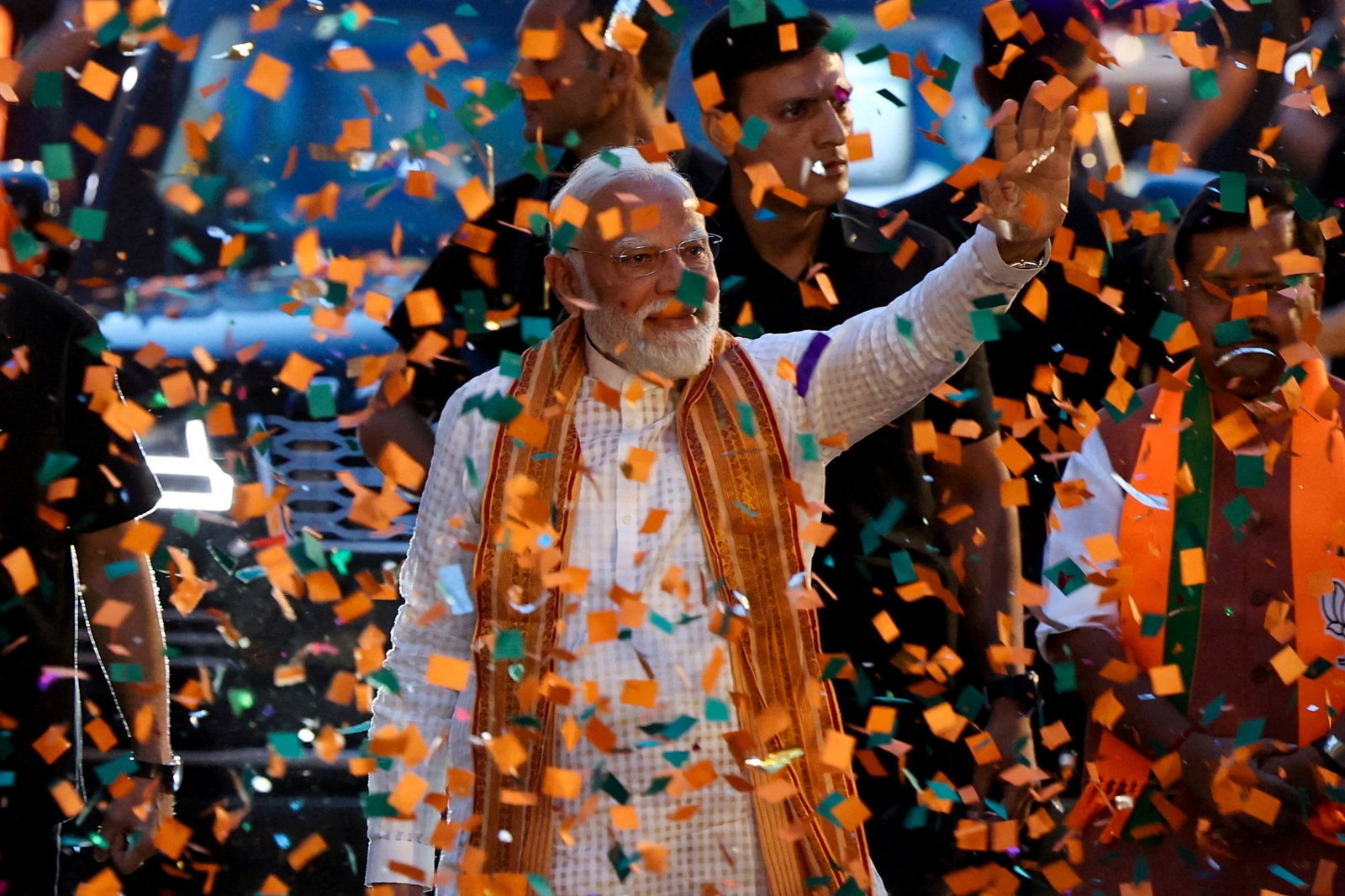
BJP’s landmark victory in West Bengal ends Mamata Banerjee’s long rule, expands Narendra Modi’s dominance eastward, and signals a major shift in India’s political balance.
In a historic political breakthrough, India’s ruling Bharatiya Janata Party (BJP) has secured victory in West Bengal, ending the 15-year dominance of Trinamool Congress (TMC) led by Mamata Banerjee.
The win marks a significant milestone for Prime Minister Narendra Modi, whose party had long struggled to gain a foothold in the politically complex eastern state of West Bengal.
A breakthrough years in the making
With a population exceeding 100 million, West Bengal represents one of India’s most electorally significant regions. For decades, it resisted the BJP’s expansion, first under Communist rule and later under Banerjee’s populist leadership.
Monday’s result signals not just a change in government but the culmination of a decade-long effort by the BJP to penetrate one of India’s toughest political frontiers. Analysts say the party steadily built its base, moving from roughly 39% of the vote in previous elections to over 44% this time.
Collapse of a political stronghold
The defeat ends one of India’s longest-standing political monopolies. The state had seen only one major transition in nearly half a century — from the Left Front’s 34-year rule to Banerjee’s TMC in 2011.
Political observers note that the TMC’s strength — its extensive grassroots network and welfare-driven support base, especially among women — began to weaken over time.
The BJP capitalized on this shift by combining welfare promises with a sharper ideological campaign, consolidating large sections of the Hindu vote while maintaining pressure on governance issues, including corruption allegations.
National ripple effects
The Bengal victory is widely seen as one of the most consequential wins of Modi’s 12-year tenure, strengthening his political dominance ahead of future national contests.
The campaign, led aggressively by Home Minister Amit Shah, is also expected to boost his standing within the BJP’s leadership hierarchy, positioning him as a key figure in the party’s future succession dynamics.
Wider electoral churn
Beyond Bengal, election results across India reflected broader political shifts. In Tamil Nadu, actor-turned-politician Vijay’s TVK staged a dramatic upset, while in Kerala, the Congress-led alliance returned to power, ending Communist rule.
However, none of these developments matched the scale or significance of the BJP’s breakthrough in Bengal.
A new political phase
For decades, West Bengal stood apart from the political currents reshaping India. With the BJP now firmly in control, that exception appears to have ended.
Analysts say the result could redefine India’s political landscape — not only consolidating Modi’s national influence but also signaling the BJP’s transformation into a truly pan-Indian political force.
The Bengal verdict, they argue, is not just a state-level shift, but the beginning of a new phase in India’s evolving political order.

