


Iran blames “unreasonable” US demands for the collapse of 21-hour Islamabad talks, as Washington insists on nuclear commitments, leaving Middle East war diplomacy at a critical deadlock.
MediaBites News
High-stakes negotiations between Iran and the United States collapsed after 21 hours in Islamabad, with Tehran accusing Washington of making “unreasonable” demands that blocked progress toward ending the Middle East conflict.
Iran’s state broadcaster, Islamic Republic of Iran Broadcasting (IRIB), said the Iranian delegation had negotiated “continuously and intensively,” but failed to reach a breakthrough due to US positions.
“The Iranian delegation negotiated continuously and intensively for 21 hours… despite various initiatives, the unreasonable demands of the American side prevented progress,” IRIB said in a statement.
Iran urges restraint, respect for rights
Iran’s Foreign Ministry spokesperson Esmaeil Baqaei described the talks as “intensive” but stressed that success depended on “seriousness and good faith” from Washington.
He urged the US to avoid “excessive demands and unlawful requests” and to respect Iran’s “legitimate rights and interests.”
Baqaei said key issues under discussion included the Strait of Hormuz, Iran’s nuclear program, and a comprehensive end to the ongoing war.
US insists on nuclear commitments
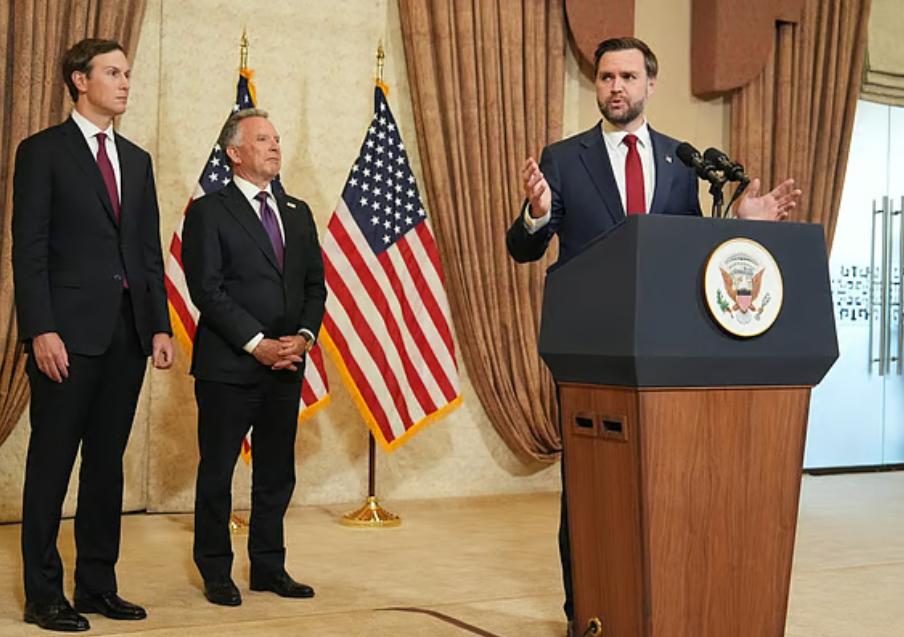
On the American side, Vice President JD Vance confirmed that talks ended without agreement after Iran refused to accept US terms, particularly regarding nuclear restrictions.
“We just could not get to a situation where the Iranians would accept our terms,” Vance said, adding that Washington’s “core goal” remains ensuring Iran does not pursue nuclear weapons.
He revealed he remained in constant contact with President Donald Trump throughout the negotiations, speaking multiple times during the marathon session.
Standing alongside envoy Steve Witkoff and adviser Jared Kushner, Vance said the US had presented its “final and best offer” to Tehran.
Deadlock despite ‘good faith’ talks
Vance maintained that the US engaged “in good faith,” but said Iran ultimately rejected key conditions tied to its nuclear program.
He described the outcome as “bad news for Iran much more than the United States.”
Pakistan praised for mediation
Despite the failure, Vance praised Pakistan’s role in facilitating the talks, thanking Prime Minister Shehbaz Sharif and Army Chief Asim Munir for their efforts.
“Any shortcomings weren’t because of the Pakistanis, who did an amazing job,” he said.
The collapse of the Islamabad talks underscores deep divisions between Tehran and Washington, leaving diplomatic efforts to end the escalating Middle East conflict in uncertainty.
Key takeaways from JD Vance’s Islamabad briefing
- 21-hour US-Iran talks ended without any agreement
- Iran rejected the US terms on nuclear restrictions
- Washington demands a firm commitment against nuclear weapons
- US presented its “final and best offer” to Tehran
- Donald Trump remained closely involved throughout negotiations
- Talks described as “in good faith” despite deadlock
- Outcome termed “bad news for Iran” by Vance
- Pakistan praised for facilitating dialogue between both sides


2 Comments
Phim Sex – Xem Phim Sex Nóng Chọn Lọc Mới Nhất – Vlxvn.Blog
Pingback: Lsm99 เว็บแทงบอลน่าเชื่อถือของแฟนบอลไทย