


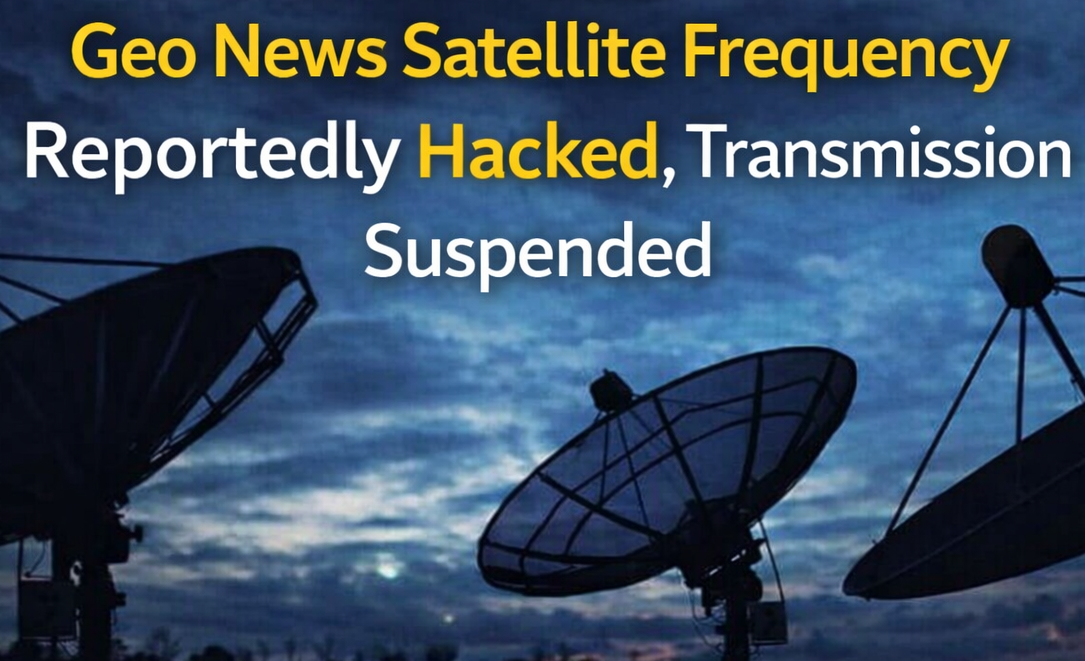
Geo News’ sudden transmission disruption was likely not a traditional hack but a case of uplink signal interference, experts say, raising serious questions about PakSat’s security, encryption standards and satellite oversight in Pakistan.
WEBDESK – Source: BBC Urdu / MediaBites News
Questions continue to swirl after Geo News’ transmission was abruptly disrupted, sparking widespread speculation on social media that the channel had been “hacked.” However, cybersecurity and satellite experts say the incident was likely not a traditional hack but a case of uplink hijacking or uplink interference.
How can a TV transmission be “hacked”?
Rafay Baloch, a cybersecurity expert and CEO of RedSec Labs, believes what happened to Geo News was most likely uplink hijacking — a documented technical phenomenon.
Speaking to the BBC, Baloch explained that, like many Pakistani TV channels, Geo uses the Pakistani satellite PakSat for transmission. The key issue, he says, is that satellites typically do not authenticate content.
“Satellites prioritize the strongest signal,” Baloch explained. “If a stronger signal is transmitted on the same frequency — with correct technical settings like modulation — it can override the existing broadcast.”
In simple terms, if a fake signal is more powerful and correctly configured on the same frequency, it can overwrite the original broadcast signal.
However, he stressed that this is not something an ordinary hacker can do from a laptop. Overpowering an existing satellite signal requires:
-
A high-power uplink transmitter
-
A large, properly installed satellite dish
-
Correct modulation and frequency parameters
-
Significant technical expertise
“This is not within reach of common individuals,” he said.
Was this PakSat’s incompetence or the channel’s failure?
Munir Jilani, a media professional with 25 years of experience and CTO at a private channel, agrees that the issue was not internal hacking but a stronger unauthorized signal fired at the uplink.
He dismissed social media claims that Geo had been “hacked.”
“A hack happens when internal infrastructure is compromised, or full system control is taken. That did not happen here,” Jilani said.
Instead, he described it as an unauthorized external signal overpowering the uplink carrier.
According to him, PakSat — operated under SUPARCO — would have full data about:
-
Where the unauthorized signal originated
-
Its power level
-
The equipment used
-
The identity of the registered transmitter
Jilani questioned why PakSat did not immediately assign Geo a new uplink carrier or frequency without affecting the downlink, allowing uninterrupted service.
“To use a simple example, if your plot number 116 is compromised, you should be shifted immediately to plot 121,” he said. “Instead, Geo had to move its entire satellite transmission to a new frequency.”
Could this happen to other channels?
Experts say yes — but it is not easy.
Such interference requires specialized equipment, regulatory permissions, and technical knowledge. Satellite hardware imports in Pakistan require NOCs and customs clearance, making unauthorized setups difficult but not impossible.
Jilani noted that this appears to be the first incident of its kind in nearly two decades, and PakSat may not have been fully prepared for such a scenario.
Six months ago, channels migrated from the older PakSat-1R to the newer MM1 satellite, which is still undergoing testing. Whether the transition played a role remains unclear.
Could encryption have prevented it?
Baloch argues that proper encryption mechanisms could have significantly reduced the risk.
Modern satellites use advanced modulation and encryption standards. If signals are encrypted, not only must the interfering signal be stronger — it must also have the correct encryption keys.
“If encryption and monitoring systems are not implemented, interference becomes relatively easier — especially if frequency and modulation parameters are publicly available through open-source intelligence,” he said.
Carrier monitoring systems also exist to detect anomalies immediately, but whether such systems were fully active remains a question.
The key unanswered question
Experts say the burden now lies with PakSat and SUPARCO to clarify:
-
Where did the unauthorized signal originate?
-
Who owned the transmitting equipment?
-
How did it overpower the official uplink?
-
Why was immediate mitigation not executed?
Until those answers emerge, the Geo News disruption remains less a “hack” and more a sophisticated case of uplink signal overpowering — raising serious questions about satellite security, encryption standards, and regulatory oversight in Pakistan’s broadcast infrastructure.


465 Comments
no deposit bonus binary options
References:
may22.ru
Downloaded the philbetapp the other day, and it’s actually pretty convenient. Easy to use, and I can place my bets on the go. Thumbs up from me! Get it here: philbetapp
sh88 is a decent option if you’re looking for variety. They got a good mix of games, and I found a couple I really enjoyed. Give it a look-see: sh88
Tried my luck at 6623ac tonight. Layout is user-friendly, and the games are entertaining. Had a couple of small wins. Give it a try yourself: 6623ac
you are really a good webmaster. The website loading speed is incredible. It seems that you’re doing any unique trick. Moreover, The contents are masterwork. you’ve done a magnificent job on this topic!
best supplement stack for mass
References:
http://www.divephotoguide.com
References:
Real dianabol for sale
References:
https://sbttravel.com.vn/football-x-by-smartsoft-a-unique-casino-game-experience-for-indian-players.html
References:
Fair To Go maximizing casino profits slot games
References:
Slot machine odds
References:
https://graph.org/Woo-Casino-Complete-Review–Player-Guide-04-20
References:
Casino sites
References:
https://120-no-deposit-casino.online-spielhallen.de/
References:
Hard rock casino tulsa
References:
https://royal-games-casino.online-spielhallen.de/
References:
Wiesbaden
References:
https://beste-online-casino-deutschland.online-spielhallen.de/
References:
Oldenburg
References:
https://casinos-in-la.online-spielhallen.de/
References:
Cologne (Köln)
References:
https://cosmo-casino-bonus-ohne-einzahlung.online-spielhallen.de/
References:
Lübeck
References:
https://gameyardorg-casino-schnelle-auszahlung.online-spielhallen.de/
References:
Pink floyd eclipse
References:
https://graph.org/How-Do-I-Verify-My-Casino-Account-04-27
I think this is among the most important info for me. And i am glad reading your article. But wanna remark on few general things, The site style is great, the articles is really nice :D. Good job, cheers
References:
List of las vegas casinos realestate.kctech.com.np
Hi there, You’ve done a great job. I’ll definitely digg it and personally recommend to my friends. I’m confident they will be benefited from this web site.
Its like you read my mind! You appear to know so much about this, like you wrote the book in it or something. I think that you could do with a few pics to drive the message home a bit, but other than that, this is magnificent blog. A great read. I’ll definitely be back.
I am glad for commenting to make you be aware of what a outstanding discovery our princess experienced studying the blog. She learned several pieces, not to mention what it is like to possess a wonderful giving spirit to get other people without difficulty thoroughly grasp specified grueling issues. You truly did more than visitors’ expected results. Thank you for presenting these powerful, healthy, educational as well as cool thoughts on this topic to Ethel.
Would you be taken with exchanging links?
Nice blog here! Also your website loads up fast! What web host are you using? Can I get your affiliate link to your host? I wish my website loaded up as quickly as yours lol
I like this web site its a master peace ! Glad I noticed this on google .
Good web site! I really love how it is simple on my eyes and the data are well written. I’m wondering how I could be notified when a new post has been made. I have subscribed to your RSS which must do the trick! Have a great day!
excellent post, very informative. I wonder why the other experts of this sector don’t notice this. You must continue your writing. I’m sure, you have a great readers’ base already!
Hello! I just would like to give a huge thumbs up for the great info you have here on this post. I will be coming back to your blog for more soon.
Thank you for another magnificent article. Where else could anyone get that type of info in such an ideal way of writing? I have a presentation next week, and I’m on the look for such information.
I’ll right away grasp your rss feed as I can’t find your email subscription link or e-newsletter service. Do you have any? Kindly allow me recognize so that I may just subscribe. Thanks.
Thank you for sharing with us, I conceive this website genuinely stands out :D.
Wohh exactly what I was looking for, appreciate it for putting up.
of course like your web-site however you need to test the spelling on quite a few of your posts. Many of them are rife with spelling issues and I to find it very bothersome to inform the truth then again I will surely come again again.
Thanks for sharing excellent informations. Your web site is so cool. I’m impressed by the details that you’ve on this blog. It reveals how nicely you understand this subject. Bookmarked this website page, will come back for more articles. You, my pal, ROCK! I found simply the info I already searched all over the place and just couldn’t come across. What an ideal web-site.
I have recently started a blog, the info you provide on this web site has helped me tremendously. Thanks for all of your time & work.
I just couldn’t depart your website before suggesting that I really enjoyed the standard info a person provide for your visitors? Is gonna be back often in order to check up on new posts
Valuable info. Lucky me I found your site by accident, and I’m shocked why this accident did not happened earlier! I bookmarked it.
WONDERFUL Post.thanks for share..extra wait .. …
Hello.This article was really fascinating, particularly since I was browsing for thoughts on this issue last Wednesday.
This web site is really a walk-through for all of the info you wanted about this and didn’t know who to ask. Glimpse here, and you’ll definitely discover it.
Thank you for helping out, wonderful information. “Considering how dangerous everything is, nothing is really very frightening.” by Gertrude Stein.
My brother recommended I may like this website. He used to be entirely right. This post truly made my day. You can not imagine simply how so much time I had spent for this info! Thanks!
Those are yours alright! . We at least need to get these people stealing images to start blogging! They probably just did a image search and grabbed them. They look good though!
Hello! Do you know if they make any plugins to assist with SEO? I’m trying to get my blog to rank for some targeted keywords but I’m not seeing very good success. If you know of any please share. Thanks!
Hey there! I just wanted to ask if you ever have any problems with hackers? My last blog (wordpress) was hacked and I ended up losing several weeks of hard work due to no data backup. Do you have any solutions to prevent hackers?
Really great info can be found on website. “The fundamental defect of fathers is that they want their children to be a credit to them.” by Bertrand Russell.
Hi there I am so happy I found your blog page, I really found you by mistake, while I was looking on Google for something else, Anyways I am here now and would just like to say thank you for a fantastic post and a all round exciting blog (I also love the theme/design), I don’t have time to go through it all at the minute but I have bookmarked it and also included your RSS feeds, so when I have time I will be back to read more, Please do keep up the awesome work.
I gotta bookmark this site it seems very useful very beneficial
Thank you for all of your efforts on this web site. Debby takes pleasure in conducting internet research and it’s really simple to grasp why. A number of us know all concerning the compelling tactic you provide valuable things by means of this blog and as well boost contribution from some other people on this area plus our own daughter is always understanding a great deal. Take pleasure in the rest of the year. You are always performing a tremendous job.
Sweet blog! I found it while surfing around on Yahoo News. Do you have any suggestions on how to get listed in Yahoo News? I’ve been trying for a while but I never seem to get there! Thank you
GELATIN HORSE RECIPE
Really superb information can be found on blog.
Good site! I truly love how it is simple on my eyes and the data are well written. I’m wondering how I might be notified when a new post has been made. I have subscribed to your RSS feed which must do the trick! Have a great day!
Its good as your other content : D, thankyou for putting up. “For peace of mind, we need to resign as general manager of the universe.” by Larry Eisenberg.
I’ve learn several just right stuff here. Definitely worth bookmarking for revisiting. I wonder how a lot attempt you place to make this kind of excellent informative web site.
jellyfil supplement
Some genuinely good blog posts on this web site, thanks for contribution.
There is noticeably a bundle to find out about this. I assume you made certain good points in features also.
Hi, I think your site might be having browser compatibility issues. When I look at your website in Safari, it looks fine but when opening in Internet Explorer, it has some overlapping. I just wanted to give you a quick heads up! Other then that, fantastic blog!
I would like to thnkx for the efforts you have put in writing this blog. I am hoping the same high-grade blog post from you in the upcoming as well. In fact your creative writing abilities has inspired me to get my own blog now. Really the blogging is spreading its wings quickly. Your write up is a good example of it.
so much superb info on here, :D.
Thankyou for this post, I am a big fan of this website would like to continue updated.
After study a few of the blog posts on your website now, and I truly like your way of blogging. I bookmarked it to my bookmark website list and will be checking back soon. Pls check out my web site as well and let me know what you think.
I really like your writing style, wonderful info, thank you for putting up :D. “Nothing sets a person so much out of the devil’s reach as humility.” by Johathan Edwards.
I carry on listening to the rumor talk about receiving boundless online grant applications so I have been looking around for the finest site to get one. Could you tell me please, where could i get some?
hello there and thank you to your information – I have definitely picked up anything new from proper here. I did on the other hand expertise some technical issues the usage of this website, since I skilled to reload the website a lot of instances previous to I may just get it to load properly. I had been puzzling over in case your web host is OK? Not that I’m complaining, but sluggish loading cases occasions will often affect your placement in google and can damage your high-quality rating if ads and ***********|advertising|advertising|advertising and *********** with Adwords. Anyway I’m including this RSS to my email and could glance out for a lot more of your respective intriguing content. Ensure that you replace this again soon..
Wohh just what I was looking for, thankyou for posting.
obviously like your web site but you have to take a look at the spelling on quite a few of your posts. Many of them are rife with spelling issues and I find it very troublesome to inform the truth on the other hand I’ll definitely come again again.
I want studying and I think this website got some truly utilitarian stuff on it! .
Does your blog have a contact page? I’m having problems locating it but, I’d like to shoot you an email. I’ve got some suggestions for your blog you might be interested in hearing. Either way, great site and I look forward to seeing it grow over time.
I’ve been exploring for a little bit for any high quality articles or weblog posts on this kind of house . Exploring in Yahoo I at last stumbled upon this site. Reading this information So i’m satisfied to convey that I have a very good uncanny feeling I discovered exactly what I needed. I such a lot certainly will make sure to don’t put out of your mind this site and give it a glance on a continuing basis.
I have to express my love for your kind-heartedness for those individuals that require help with this one theme. Your real dedication to getting the solution up and down became certainly important and has continually helped women just like me to get to their goals. Your amazing important guide implies so much to me and substantially more to my office colleagues. Regards; from everyone of us.
Right now it looks like Movable Type is the top blogging platform available right now. (from what I’ve read) Is that what you are using on your blog?
Hiya very cool blog!! Guy .. Beautiful .. Superb .. I’ll bookmark your blog and take the feeds additionally…I’m happy to find so many useful information here within the submit, we’d like develop more strategies in this regard, thanks for sharing.
Howdy this is kinda of off topic but I was wanting to know if blogs use WYSIWYG editors or if you have to manually code with HTML. I’m starting a blog soon but have no coding skills so I wanted to get guidance from someone with experience. Any help would be enormously appreciated!
I loved as much as you’ll receive carried out right here. The sketch is tasteful, your authored material stylish. nonetheless, you command get got an impatience over that you wish be delivering the following. unwell unquestionably come further formerly again since exactly the same nearly very often inside case you shield this hike.
I don’t even understand how I stopped up here, however I assumed this put up was once great. I do not understand who you are but certainly you’re going to a well-known blogger if you aren’t already 😉 Cheers!
As a Newbie, I am continuously searching online for articles that can benefit me. Thank you
I’ve read some just right stuff here. Definitely worth bookmarking for revisiting. I wonder how much attempt you set to make any such fantastic informative web site.
Simply wanna comment on few general things, The website pattern is perfect, the written content is real wonderful. “Good judgment comes from experience, and experience comes from bad judgment.” by Barry LePatner.
I just couldn’t go away your web site before suggesting that I extremely loved the standard information a person provide on your visitors? Is going to be back steadily in order to inspect new posts
As I web-site possessor I believe the content matter here is rattling excellent , appreciate it for your efforts. You should keep it up forever! Good Luck.
My brother suggested I would possibly like this website. He was totally right. This post actually made my day. You cann’t consider just how much time I had spent for this info! Thanks!
Hello there! I could have sworn I’ve been to this website before but after checking through some of the post I realized it’s new to me. Nonetheless, I’m definitely happy I found it and I’ll be book-marking and checking back often!
You have brought up a very wonderful points, appreciate it for the post.
Howdy would you mind letting me know which hosting company you’re using? I’ve loaded your blog in 3 different browsers and I must say this blog loads a lot faster then most. Can you recommend a good web hosting provider at a reasonable price? Thank you, I appreciate it!
Real superb visual appeal on this internet site, I’d value it 10 10.
Well I definitely liked studying it. This information offered by you is very practical for good planning.
Hi, I think your site might be having browser compatibility issues. When I look at your website in Safari, it looks fine but when opening in Internet Explorer, it has some overlapping. I just wanted to give you a quick heads up! Other then that, fantastic blog!
What Is the Horse Gelatin Trick For Men
Very nice post. I simply stumbled upon your weblog and wished to say that I’ve really enjoyed browsing your weblog posts. After all I will be subscribing on your feed and I hope you write once more very soon!
Hello, i feel that i saw you visited my site so i got here to “go back the desire”.I’m trying to to find issues to improve my web site!I suppose its adequate to make use of some of your concepts!!
Some really interesting points you have written.Assisted me a lot, just what I was searching for :D.
Excellent read, I just passed this onto a colleague who was doing some research on that. And he just bought me lunch since I found it for him smile Therefore let me rephrase that: Thanks for lunch! “One who’s our friend is fond of us one who’s fond of us isn’t necessarily our friend.” by Geoffrey F. Albert.
I believe this is among the such a lot important information for me. And i am happy studying your article. But should commentary on few common issues, The web site style is wonderful, the articles is truly great :D. Just right activity, cheers
You completed a few fine points there. I did a search on the subject and found nearly all people will have the same opinion with your blog.
You have brought up a very fantastic details , thanks for the post.
Thankyou for this post, I am a big big fan of this web site would like to go along updated.
Hey, you used to write fantastic, but the last few posts have been kinda boringK I miss your super writings. Past several posts are just a little bit out of track! come on!
Write more, thats all I have to say. Literally, it seems as though you relied on the video to make your point. You definitely know what youre talking about, why throw away your intelligence on just posting videos to your blog when you could be giving us something informative to read?
I conceive this website has some really superb info for everyone :D.
I would like to show some appreciation to this writer for rescuing me from this matter. Just after scouting throughout the search engines and coming across views which are not beneficial, I was thinking my life was well over. Living devoid of the answers to the issues you’ve resolved through your short article is a serious case, as well as the kind which might have adversely affected my career if I hadn’t noticed your web site. Your actual know-how and kindness in taking care of every item was tremendous. I’m not sure what I would have done if I had not discovered such a point like this. I can also now relish my future. Thanks for your time so much for the impressive and results-oriented guide. I won’t hesitate to endorse your blog post to any person who requires tips about this issue.
Really informative and wonderful body structure of subject matter, now that’s user friendly (:.
Hi there! Quick question that’s completely off topic. Do you know how to make your site mobile friendly? My web site looks weird when viewing from my apple iphone. I’m trying to find a template or plugin that might be able to correct this issue. If you have any recommendations, please share. Thanks!
I would like to thnkx for the efforts you have put in writing this blog. I am hoping the same high-grade blog post from you in the upcoming as well. In fact your creative writing abilities has inspired me to get my own blog now. Really the blogging is spreading its wings quickly. Your write up is a good example of it.
I believe this web site holds some rattling wonderful info for everyone :D. “Nothing great was ever achieved without enthusiasm.” by Ralph Waldo Emerson.
Thankyou for this grand post, I am glad I discovered this internet site on yahoo.
It’s the best time to make some plans for the future and it’s time to be happy. I have read this post and if I could I want to suggest you few interesting things or advice. Perhaps you can write next articles referring to this article. I wish to read more things about it!
I think this is one of the most significant information for me. And i’m glad reading your article. But should remark on some general things, The website style is perfect, the articles is really excellent :D. Good job, cheers
You have brought up a very great points, thanks for the post.
Outstanding post, you have pointed out some excellent details , I besides think this s a very great website.
You are my inhalation, I possess few web logs and very sporadically run out from to post : (.
I have recently started a web site, the information you provide on this website has helped me greatly. Thank you for all of your time & work. “Marriage love, honor, and negotiate.” by Joe Moore.
I like what you guys are up too. Such clever work and reporting! Keep up the excellent works guys I’ve incorporated you guys to my blogroll. I think it’ll improve the value of my site :).
Enjoyed reading through this, very good stuff, thanks. “I will do my best. That is all I can do. I ask for your help-and God’s.” by Lyndon B. Johnson.
Thank you, I’ve just been looking for info approximately this subject for ages and yours is the greatest I have came upon till now. However, what concerning the bottom line? Are you certain in regards to the source?
Some really interesting info , well written and loosely user genial.
I used to be more than happy to seek out this internet-site.I wished to thanks in your time for this wonderful learn!! I definitely having fun with every little bit of it and I’ve you bookmarked to take a look at new stuff you blog post.
BAKING SODA TRICK RECIPE FOR WEIGHT LOSS
Very interesting details you have mentioned, thankyou for putting up.
Somebody necessarily lend a hand to make seriously articles I would state. That is the very first time I frequented your web page and to this point? I surprised with the research you made to make this particular submit amazing. Magnificent task!
Thank you for every other informative web site. Where else could I am getting that type of info written in such a perfect manner? I’ve a project that I am just now operating on, and I’ve been on the glance out for such information.
I really like your writing style, good info , regards for putting up :D.
Whats up very nice blog!! Man .. Excellent .. Wonderful .. I will bookmark your site and take the feeds alsoKI’m satisfied to find so many useful info right here within the publish, we need work out extra techniques on this regard, thank you for sharing. . . . . .
Hello! I’ve been reading your web site for a long time now and finally got the bravery to go ahead and give you a shout out from Lubbock Tx! Just wanted to mention keep up the good job!
This is really attention-grabbing, You are an overly skilled blogger. I have joined your rss feed and sit up for looking for more of your excellent post. Also, I’ve shared your website in my social networks!
I do not even know how I ended up here, but I thought this post was great. I don’t know who you are but certainly you are going to a famous blogger if you aren’t already 😉 Cheers!
My brother recommended I might like this blog. He was entirely right. This post truly made my day. You cann’t imagine simply how much time I had spent for this info! Thanks!
Nice post. I was checking continuously this blog and I am impressed! Very useful information specifically the last part 🙂 I care for such info a lot. I was seeking this certain info for a very long time. Thank you and good luck.
hello!,I like your writing very much! share we communicate more about your post on AOL? I need a specialist on this area to solve my problem. Maybe that’s you! Looking forward to see you.
Would you be inquisitive about exchanging links?
I like the valuable info you provide in your articles. I’ll bookmark your weblog and check again here frequently. I’m quite certain I will learn many new stuff right here! Best of luck for the next!
JELLYFIL
Thanks for sharing superb informations. Your web-site is very cool. I’m impressed by the details that you have on this web site. It reveals how nicely you understand this subject. Bookmarked this website page, will come back for more articles. You, my friend, ROCK! I found just the information I already searched all over the place and simply couldn’t come across. What a perfect site.
References:
Legiano Casino Web App https://mystic.astroempires.com/
References:
Legiano Casino Echtgeld http://www.google.vg/url?q=https://www.bigsoccer.com/proxy.php?link=https://de.trustpilot.com/review/beyondjewellery.de
References:
Legiano Casino seriös http://maps.google.com.sg
References:
Legiano Casino Mobile http://www.freethesaurus.com
References:
Legiano Casino Live Casino plitkat.ru
References:
Legiano Casino Auszahlungsdauer https://rusnor.org/bitrix/redirect.php?event1=&event2=&event3=&goto=https://vocab.getty.edu/resource?uri=https://de.trustpilot.com/review/beyondjewellery.de
References:
Legiano Casino Umsatzbedingungen encyclopedia2.thefreedictionary.com
Spot on with this write-up, I actually think this website wants far more consideration. I’ll most likely be once more to read far more, thanks for that info.
References:
Legiano Casino Zahlungsmethoden http://aintedles.yoo7.com
References:
Legiano Casino 2026 alt1.toolbarqueries.google.tk
I like reading and I believe this website got some genuinely useful stuff on it! .
References:
Legiano Casino Kritik https://anon.to
References:
Legiano Casino Promo Code metager.de
References:
Legiano Casino 2026 http://polsy.org.uk/play/yt/?vurl=https://de.trustpilot.com/review/edelkranz.de
What’s Going down i am new to this, I stumbled upon this I’ve discovered It positively helpful and it has aided me out loads. I hope to give a contribution & aid other customers like its helped me. Great job.
References:
Legiano Casino Kontakt parrots.ru
References:
Kingmaker Casino Dauer Auszahlung https://slk.lat/
References:
KingMaker Casino Registrierungsbonus https://qr.dsd.edu.gh
References:
KingMaker einzahlung google pay https://smartbusinesscards.in
References:
Kingmaker Casino Blackjack link.epicalorie.shop
I love your blog.. very nice colors & theme. Did you create this website yourself? Plz reply back as I’m looking to create my own blog and would like to know wheere u got this from. thanks
References:
KingMaker Casino Einzahlung Casino Bonus http://www.google.com.mx/url?sa=t&url=https://de.trustpilot.com/review/beyondjewellery.de
References:
Kingmaker Casino Freispiele ohne Einzahlung http://crazyfrag91.free.fr/?URL=de.trustpilot.com%2Freview%2Fbeyondjewellery.de
Greetings from Carolina! I’m bored to tears at work so I decided to browse your website on my iphone during lunch break. I really like the information you present here and can’t wait to take a look when I get home. I’m amazed at how fast your blog loaded on my phone .. I’m not even using WIFI, just 3G .. Anyhow, good blog!
References:
KingMaker Casino Einzahlung 2025 http://images.google.bi/url?q=https://de.trustpilot.com/review/beyondjewellery.de
References:
Kingmaker Casino Mirror Link http://forum.cmsheaven.org/proxy.php?link=https://de.trustpilot.com/review/beyondjewellery.de
References:
KingMaker Casino Einzahlung mit Bankeinzug http://image.google.com.af/url?q=https://de.trustpilot.com/review/beyondjewellery.de
References:
Legiano Casino Lizenz http://cr.naver.com/redirect-notification?u=https%3A%2F%2Fliteraturewiki.site%2Fwiki%2FOffizielle_sterreich_Seite
References:
Legiano Casino Deutschland http://maps.google.sn/url?q=https://bridgedesign.site/wiki/Leguano_Barfussschuh_Gr_37_schwarz_30_1110_Wien
References:
Legiano Casino Lizenz https://structurizr.com/help/theme?url=https%3A%2F%2Fbright-mahler-8.thoughtlanes.net/legiano-casino-test-bonus-and-erfahrungen
References:
Legiano Casino Bonus ohne Einzahlung https://www.rufox.com/go.php?url=https://gratisafhalen.be/author/advicebit43/
References:
Legiano Casino Android http://aintedles.yoo7.com/go/aHR0cHM6Ly9jb25jcmV0ZXdpa2kuc2l0ZS93aWtpL0xlZ2lhbm9fY2FzaW5vX2xvZ2luX0RldXRzY2hsYW5kX1NwaWVsZW5fU2llX2pldHp0X2ltX2Nhc2lub19MZWdpYW5v
References:
Legiano Casino Gutscheincode https://forum.cmsheaven.org/proxy.php?link=https://telegra.ph/Legiano-casino-login-konto-erstellen-wie-anmelden-06-07-3
I’ve been browsing on-line more than 3 hours nowadays, yet I by no means found any interesting article like yours. It’s beautiful price enough for me. In my view, if all website owners and bloggers made excellent content material as you did, the web will be a lot more useful than ever before.
References:
Legiano Casino Promo Code https://cm.lesta.ru/frame/?backend_url=//bit.ly/opsuimolog5012&content_layout_max_width=1335&language=ru&login_url=https://truckwiki.site/wiki/Die_10_besten_Hotels_in_Lignano_Sabbiadoro_Italien_Ab_65
References:
Legiano Casino http://images.google.com.qa/url?sa=t&url=https://telegra.ph/Luxus-Apartment-mit-4-Zimmer-zu-verkaufen-in-Lungomare-Trieste-134-Lignano-Udine-Friaul-Venetien-132645250-06-07
References:
Legiano Casino Anmeldung https://imslp.org/api.php?action=https://architecturewiki.site/wiki/Spiele_Wetten_exklusive_Aktionen_online
References:
Legiano Casino Gratis Spins http://cse.google.it/url?q=https://sonnik.nalench.com/user/taurusnepal19/
References:
Legiano Casino Paysafecard http://cse.google.com.ag/url?sa=t&url=http%3A%2F%2Fmolchanovonews.ru%2Fuser%2Fdollarping02%2F
References:
Legiano Casino Mindestauszahlung http://maps.google.lk/url?q=https%3A%2F%2Fcallahan-blanton.hubstack.net%2Fonline-casino-test-2026-experten-erfahrungen-and-bewertung
Good day! Do you know if they make any plugins to protect against hackers? I’m kinda paranoid about losing everything I’ve worked hard on. Any tips?
I am pleased that I detected this weblog, precisely the right information that I was searching for! .
An impressive share, I just given this onto a colleague who was doing a little analysis on this. And he in fact bought me breakfast because I found it for him.. smile. So let me reword that: Thnx for the treat! But yeah Thnkx for spending the time to discuss this, I feel strongly about it and love reading more on this topic. If possible, as you become expertise, would you mind updating your blog with more details? It is highly helpful for me. Big thumb up for this blog post!
References:
Hitnspin casino gutscheincode http://fahrschule-stuwe-tuebingen.de/htsrv/login.php?redirect_to=https://board-en.farmerama.com:443/proxy.php?link=https://de.trustpilot.com/review/der-wikinger-shop.de
I’m really loving the theme/design of your weblog. Do you ever run into any internet browser compatibility issues? A handful of my blog audience have complained about my blog not operating correctly in Explorer but looks great in Firefox. Do you have any tips to help fix this problem?
References:
Hit n spin casino login http://clients1.google.com.ag/url?sa=t&url=https%3A%2F%2Fwww.fcterc.gov.ng%2F%3FURL%3Dhttps%3A%2F%2Fde.trustpilot.com%2Freview%2Fder-wikinger-shop.de
References:
Hitnspin casino app android https://secure.javhd.com/login/?wl=1&back=vocab.getty.edu%2Fresource%3Furi%3Dhttps%3A%2F%2Fde.trustpilot.com%2Freview%2Fder-wikinger-shop.de&path=lw&lang=en
References:
Hit’n’spin casino login http://cse.google.com.pk/url?q=https://sc.news.gov.hk/TuniS/de.trustpilot.com%2Freview%2Fder-wikinger-shop.de
References:
Monro Casino Bonus Code http://close-up.ru/bitrix/redirect.php?event1=&event2=&event3=&goto=https://innvo.pro/deneselons
Thanks for the sensible critique. Me & my neighbor were just preparing to do some research about this. We got a grab a book from our area library but I think I learned more from this post. I am very glad to see such great information being shared freely out there.
I dugg some of you post as I cerebrated they were invaluable very beneficial
Wow that was odd. I just wrote an extremely long comment but after I clicked submit my comment didn’t show up. Grrrr… well I’m not writing all that over again. Anyhow, just wanted to say great blog!
Hello there, You’ve performed a fantastic job. I will definitely digg it and for my part suggest to my friends. I am confident they will be benefited from this site.
References:
Hit n spin promo code https://www.mauocsp.ru/bitrix/redirect.php?event1=click_to_call&event2=&event3=&goto=https://4gameforum.com/proxy.php?link=https://de.trustpilot.com/review/der-wikinger-shop.de
Hello my friend! I want to say that this article is awesome, nice written and include almost all significant infos. I would like to see more posts like this.
References:
Hit’n spin casino https://community.playstarbound.com/proxy.php?link=https://gardenwiki.site/wiki/HitnSpin_Casino_Test_Objektive_Casino_Bewertung_Erfahrungen
Rattling excellent info can be found on website.
With every thing which appears to be developing throughout this particular subject matter, all your perspectives are very exciting. Nonetheless, I am sorry, because I do not subscribe to your entire plan, all be it exciting none the less. It would seem to everyone that your commentary are actually not totally justified and in actuality you are yourself not fully confident of your argument. In any case I did appreciate examining it.
JELLYFIL REVIEWS
jellyfill review
References:
Lollybet Casino Bonusbedingungen http://toolbarqueries.google.st/url?sa=t&url=http://forum-makarova.ru/proxy.php?link=https://lollybet.com.de/
naturally like your website however you need to take a look at the spelling on several of your posts. Many of them are rife with spelling problems and I in finding it very troublesome to inform the truth then again I will surely come back again.
I enjoy the efforts you have put in this, thank you for all the great content.
My partner and I absolutely love your blog and find the majority of your post’s to be just what I’m looking for. Would you offer guest writers to write content in your case? I wouldn’t mind writing a post or elaborating on many of the subjects you write in relation to here. Again, awesome website!
Woah! I’m really enjoying the template/theme of this website. It’s simple, yet effective. A lot of times it’s tough to get that “perfect balance” between superb usability and visual appearance. I must say you’ve done a amazing job with this. Additionally, the blog loads extremely fast for me on Opera. Outstanding Blog!
After I originally commented I clicked the -Notify me when new feedback are added- checkbox and now each time a remark is added I get four emails with the identical comment. Is there any means you’ll be able to take away me from that service? Thanks!
What i do not understood is in fact how you’re not actually a lot more neatly-preferred than you might be now. You are so intelligent. You realize therefore significantly when it comes to this subject, made me in my opinion consider it from numerous various angles. Its like women and men are not interested except it is one thing to accomplish with Lady gaga! Your personal stuffs nice. At all times deal with it up!
You could certainly see your expertise within the paintings you write. The world hopes for more passionate writers such as you who aren’t afraid to say how they believe. Always go after your heart.
Heya just wanted to give you a brief heads up and let you know a few of the images aren’t loading properly. I’m not sure why but I think its a linking issue. I’ve tried it in two different web browsers and both show the same results.
I genuinely enjoy looking through on this website , it has great articles. “The great secret of power is never to will to do more than you can accomplish.” by Henrik Ibsen.
It’s actually a great and helpful piece of information. I’m glad that you shared this useful information with us. Please keep us informed like this. Thank you for sharing.
Exactly what I was searching for, thanks for putting up.
I think this is among the most important info for me. And i am glad reading your article. But should remark on few general things, The website style is wonderful, the articles is really nice :D. Good job, cheers
This is a very good tips especially to those new to blogosphere, brief and accurate information… Thanks for sharing this one. A must read article.
Some genuinely tremendous work on behalf of the owner of this site, utterly outstanding articles.
wonderful points altogether, you just gained a brand new reader. What would you suggest in regards to your post that you made a few days ago? Any positive?
As I website possessor I believe the content matter here is rattling great , appreciate it for your efforts. You should keep it up forever! Best of luck.
Having read this I thought it was very informative. I appreciate you taking the time and effort to put this article together. I once again find myself spending way to much time both reading and commenting. But so what, it was still worth it!
Thankyou for all your efforts that you have put in this. very interesting info .
I am curious to find out what blog platform you are working with? I’m having some small security problems with my latest site and I would like to find something more safe. Do you have any recommendations?
Lovely just what I was searching for.Thanks to the author for taking his clock time on this one.
hello there and thank you in your info – I’ve definitely picked up anything new from proper here. I did on the other hand experience several technical points the usage of this web site, since I skilled to reload the website a lot of instances previous to I may get it to load properly. I were brooding about if your web hosting is OK? No longer that I am complaining, however sluggish loading cases occasions will very frequently affect your placement in google and can damage your high quality ranking if advertising and ***********|advertising|advertising|advertising and *********** with Adwords. Well I am adding this RSS to my email and can look out for much extra of your respective fascinating content. Make sure you update this once more soon..
We absolutely love your blog and find the majority of your post’s to be what precisely I’m looking for. Would you offer guest writers to write content available for you? I wouldn’t mind producing a post or elaborating on a few of the subjects you write with regards to here. Again, awesome site!
References:
Slots of vegas no deposit https://body-positivity.org/groups/instant-casino-deutschland-%ef%b8%8f-exklusiver-promo-code-und-vip-programm/
I got what you mean , appreciate it for putting up.Woh I am glad to find this website through google. “Delay is preferable to error.” by Thomas Jefferson.
References:
Ashley revell https://www.workbay.online/profile/brodericksprin
I am typically to running a blog and i really respect your content. The article has really peaks my interest. I’m going to bookmark your website and maintain checking for new information.
I like the valuable information you provide in your articles. I’ll bookmark your blog and check again here frequently. I’m quite certain I’ll learn plenty of new stuff right here! Good luck for the next!
I’d forever want to be update on new blog posts on this internet site, bookmarked! .
I’d forever want to be update on new articles on this website , saved to my bookmarks! .
It’s really a cool and helpful piece of info. I am glad that you simply shared this useful information with us. Please stay us up to date like this. Thank you for sharing.
I love your blog.. very nice colors & theme. Did you create this website yourself? Plz reply back as I’m looking to create my own blog and would like to know wheere u got this from. thanks
That is really fascinating, You’re a very professional blogger. I’ve joined your rss feed and look forward to in search of more of your fantastic post. Additionally, I’ve shared your website in my social networks!
A large percentage of of what you claim is supprisingly appropriate and that makes me ponder the reason why I had not looked at this in this light previously. This article really did turn the light on for me as far as this specific subject matter goes. Nonetheless at this time there is actually 1 point I am not really too cozy with and whilst I attempt to reconcile that with the actual central idea of the position, permit me see just what the rest of the readers have to point out.Well done.
I am so happy to read this. This is the kind of manual that needs to be given and not the accidental misinformation that is at the other blogs. Appreciate your sharing this best doc.
Absolutely pent subject matter, thank you for information. “In the fight between you and the world, back the world.” by Frank Zappa.
Excellent read, I just passed this onto a colleague who was doing some research on that. And he actually bought me lunch because I found it for him smile Therefore let me rephrase that: Thank you for lunch! “We steal if we touch tomorrow. It is God’s.” by Henry Ward Beecher.
Its great as your other content : D, regards for putting up. “Age is a function of mind over matter if you don’t mind, it doesn’t matter.” by Leroy Robert Satchel Paige.
Excellent blog here! Also your website loads up fast! What web host are you using? Can I get your affiliate link to your host? I wish my web site loaded up as fast as yours lol
I would like to thnkx for the efforts you have put in writing this blog. I am hoping the same high-grade blog post from you in the upcoming as well. In fact your creative writing abilities has inspired me to get my own blog now. Really the blogging is spreading its wings quickly. Your write up is a good example of it.
After study a few of the blog posts on your website now, and I truly like your way of blogging. I bookmarked it to my bookmark website list and will be checking back soon. Pls check out my web site as well and let me know what you think.
I’m also commenting to make you know what a helpful discovery our princess experienced using your web site. She came to find a good number of details, with the inclusion of what it is like to possess a great coaching heart to have many more without hassle learn about several complex subject areas. You really did more than my expected results. Many thanks for churning out the effective, trustworthy, educational not to mention cool thoughts on your topic to Mary.
great post, very informative. I wonder why the other specialists of this sector don’t realize this. You must continue your writing. I’m sure, you have a huge readers’ base already!
Whats up very nice blog!! Man .. Beautiful .. Wonderful .. I’ll bookmark your blog and take the feeds alsoKI’m satisfied to seek out so many useful information right here within the submit, we’d like develop more techniques on this regard, thanks for sharing. . . . . .
I’ll immediately take hold of your rss as I can’t to find your e-mail subscription hyperlink or e-newsletter service. Do you’ve any? Kindly let me recognize in order that I may just subscribe. Thanks.
Nice read, I just passed this onto a colleague who was doing some research on that. And he just bought me lunch because I found it for him smile Therefore let me rephrase that: Thank you for lunch!
Heya i’m for the first time here. I came across this board and I find It truly useful & it helped me out a lot. I hope to give something back and aid others like you aided me.
I visited a lot of website but I conceive this one contains something special in it in it
Excellent items from you, man. I have consider your stuff prior to and you are simply extremely magnificent. I really like what you have received here, certainly like what you’re saying and the way in which through which you say it. You’re making it entertaining and you continue to care for to stay it smart. I can not wait to read far more from you. This is really a tremendous web site.
An interesting discussion is worth comment. I think that you should write more on this topic, it might not be a taboo subject but generally people are not enough to speak on such topics. To the next. Cheers
Excellent read, I just passed this onto a colleague who was doing some research on that. And he just bought me lunch since I found it for him smile So let me rephrase that: Thank you for lunch! “By nature, men are nearly alike by practice, they get to be wide apart.” by Confucius.
I am really enjoying the theme/design of your weblog. Do you ever run into any web browser compatibility issues? A couple of my blog readers have complained about my website not working correctly in Explorer but looks great in Chrome. Do you have any solutions to help fix this problem?
Greetings! I know this is somewhat off topic but I was wondering if you knew where I could locate a captcha plugin for my comment form? I’m using the same blog platform as yours and I’m having problems finding one? Thanks a lot!
Thanks for another informative web site. Where else could I get that kind of info written in such an ideal way? I’ve a project that I am just now working on, and I’ve been on the look out for such information.
I like this post, enjoyed this one regards for putting up.
I’m impressed, I must say. Actually not often do I encounter a blog that’s both educative and entertaining, and let me tell you, you may have hit the nail on the head. Your idea is outstanding; the problem is one thing that not sufficient people are speaking intelligently about. I am very glad that I stumbled throughout this in my seek for something regarding this.
My brother suggested I may like this web site. He was totally right. This put up actually made my day. You cann’t believe simply how so much time I had spent for this info! Thank you!
I like what you guys are up also. Such smart work and reporting! Keep up the superb works guys I’ve incorporated you guys to my blogroll. I think it’ll improve the value of my web site 🙂
It’s hard to find knowledgeable people on this topic, but you sound like you know what you’re talking about! Thanks
I am often to blogging and i really appreciate your content. The article has really peaks my interest. I am going to bookmark your site and keep checking for new information.
It’s really a great and helpful piece of information. I’m happy that you simply shared this useful information with us. Please keep us informed like this. Thanks for sharing.
Hi my loved one! I wish to say that this article is amazing, great written and come with approximately all important infos. I’d like to look extra posts like this .
Pretty! This was a really wonderful post. Thank you for your provided information.
There is noticeably a bundle to know about this. I assume you made sure nice factors in features also.
Wow, awesome blog layout! How long have you been blogging for? you make blogging look easy. The overall look of your website is great, let alone the content!
Very interesting subject, appreciate it for posting.
Pretty section of content. I just stumbled upon your site and in accession capital to assert that I get actually enjoyed account your blog posts. Any way I will be subscribing to your augment and even I achievement you access consistently fast.
Great wordpress blog here.. It’s hard to find quality writing like yours these days. I really appreciate people like you! take care
Perfectly composed articles, Really enjoyed looking at.
It’s really a nice and helpful piece of info. I’m satisfied that you just shared this useful information with us. Please stay us informed like this. Thank you for sharing.
Thank you for any other magnificent post. The place else may anybody get that type of info in such a perfect way of writing? I’ve a presentation subsequent week, and I’m on the search for such info.
I like the efforts you have put in this, regards for all the great content.
Hello there, I discovered your site by means of Google even as looking for a similar matter, your website came up, it appears great. I’ve bookmarked it in my google bookmarks.
I used to be very pleased to seek out this net-site.I wished to thanks for your time for this glorious learn!! I definitely having fun with every little bit of it and I have you bookmarked to check out new stuff you weblog post.
I am glad to be one of many visitants on this outstanding website (:, thanks for posting.
Hello There. I found your blog using msn. This is a really well written article. I’ll make sure to bookmark it and return to read more of your useful information. Thanks for the post. I’ll certainly return.
Great work! That is the kind of information that are meant to be shared across the net. Disgrace on the seek engines for no longer positioning this post higher! Come on over and consult with my web site . Thanks =)
Having read this I thought it was very informative. I appreciate you taking the time and effort to put this article together. I once again find myself spending way to much time both reading and commenting. But so what, it was still worth it!
Thanks for the sensible critique. Me and my neighbor were just preparing to do a little research on this. We got a grab a book from our local library but I think I learned more clear from this post. I’m very glad to see such fantastic info being shared freely out there.
Normally I don’t read article on blogs, however I wish to say that this write-up very forced me to take a look at and do so! Your writing style has been amazed me. Thank you, quite great post.
Can I just say what a relief to find someone who actually knows what theyre talking about on the internet. You definitely know how to bring an issue to light and make it important. More people need to read this and understand this side of the story. I cant believe youre not more popular because you definitely have the gift.
You made some respectable factors there. I looked on the internet for the issue and located most individuals will go along with along with your website.
Yeah bookmaking this wasn’t a high risk determination outstanding post! .
I really appreciate this post. I have been looking all over for this! Thank goodness I found it on Bing. You’ve made my day! Thanks again
Yeah bookmaking this wasn’t a bad determination great post! .
I used to be very happy to search out this web-site.I needed to thanks to your time for this glorious learn!! I positively having fun with each little bit of it and I have you bookmarked to check out new stuff you blog post.
Hey would you mind letting me know which hosting company you’re working with? I’ve loaded your blog in 3 different web browsers and I must say this blog loads a lot quicker then most. Can you suggest a good hosting provider at a fair price? Kudos, I appreciate it!
I just couldn’t go away your website before suggesting that I extremely enjoyed the usual info an individual supply for your guests? Is going to be again ceaselessly in order to check up on new posts
Would you be taken with exchanging links?
Good write-up, I am normal visitor of one’s web site, maintain up the excellent operate, and It’s going to be a regular visitor for a long time.
Hi, I think your blog might be having browser compatibility issues. When I look at your website in Firefox, it looks fine but when opening in Internet Explorer, it has some overlapping. I just wanted to give you a quick heads up! Other then that, amazing blog!
What i do not understood is actually how you’re not really much more well-liked than you may be now. You’re very intelligent. You realize thus significantly relating to this subject, made me personally consider it from so many varied angles. Its like men and women aren’t fascinated unless it is one thing to do with Lady gaga! Your own stuffs excellent. Always maintain it up!
Very interesting subject, appreciate it for putting up.
Thanks, I have just been searching for info about this subject for ages and yours is the greatest I’ve discovered so far. However, what in regards to the conclusion? Are you sure about the source?
Thanks for another informative website. Where else could I get that kind of info written in such an ideal means? I’ve a undertaking that I’m just now running on, and I have been at the glance out for such information.
Hello there! I could have sworn I’ve been to this website before but after browsing through some of the post I realized it’s new to me. Anyways, I’m definitely glad I found it and I’ll be book-marking and checking back often!
Hello.This article was really motivating, especially since I was investigating for thoughts on this topic last couple of days.
Hey! I could have sworn I’ve been to this website before but after browsing through some of the post I realized it’s new to me. Nonetheless, I’m definitely happy I found it and I’ll be book-marking and checking back frequently!
Hey would you mind letting me know which hosting company you’re using? I’ve loaded your blog in 3 different internet browsers and I must say this blog loads a lot quicker then most. Can you recommend a good hosting provider at a reasonable price? Thanks a lot, I appreciate it!
Very interesting information!Perfect just what I was looking for! “Love endures only when the lovers love many things together and not merely each other.” by Walter Lippmann.
I’ll immediately grasp your rss feed as I can’t find your email subscription hyperlink or newsletter service. Do you have any? Please let me realize in order that I may just subscribe. Thanks.
Only wanna input on few general things, The website design and style is perfect, the subject material is real great. “War is much too serious a matter to be entrusted to the military.” by Georges Clemenceau.
Hola! I’ve been following your web site for a while now and finally got the courage to go ahead and give you a shout out from Humble Texas! Just wanted to say keep up the excellent job!
Your place is valueble for me. Thanks!…
Magnificent goods from you, man. I have take into account your stuff previous to and you’re simply extremely wonderful. I really like what you’ve obtained right here, really like what you are stating and the best way in which you assert it. You are making it enjoyable and you still take care of to stay it wise. I can’t wait to read much more from you. This is actually a great website.
I’ve been browsing online greater than three hours today, yet I never found any interesting article like yours. It is lovely value sufficient for me. In my opinion, if all web owners and bloggers made good content material as you did, the internet might be much more helpful than ever before. “Learn to see in another’s calamity the ills which you should avoid.” by Publilius Syrus.
Thanks a lot for providing individuals with an extraordinarily nice possiblity to read in detail from this web site. It is often so brilliant and also full of fun for me personally and my office acquaintances to visit your site minimum three times a week to see the latest things you will have. And indeed, we are at all times fascinated considering the beautiful tricks served by you. Selected two areas in this posting are ultimately the most effective we have all had.
I’m curious to find out what blog system you’re working with? I’m experiencing some small security issues with my latest website and I would like to find something more safe. Do you have any solutions?
Hi there just wanted to give you a quick heads up. The words in your article seem to be running off the screen in Chrome. I’m not sure if this is a format issue or something to do with browser compatibility but I figured I’d post to let you know. The layout look great though! Hope you get the problem resolved soon. Many thanks
I love it when people come together and share opinions, great blog, keep it up.
Your style is so unique compared to many other people. Thank you for publishing when you have the opportunity,Guess I will just make this bookmarked.
I have been browsing online more than three hours today, yet I never found any interesting article like yours. It is pretty worth enough for me. Personally, if all web owners and bloggers made good content as you did, the web will be much more useful than ever before.
I love what you guys tend to be up too. This kind of clever work and coverage! Keep up the fantastic works guys I’ve incorporated you guys to blogroll.
hey there and thank you to your info – I’ve definitely picked up something new from proper here. I did alternatively expertise a few technical issues the use of this web site, since I skilled to reload the web site lots of occasions previous to I could get it to load correctly. I had been pondering if your web hosting is OK? Now not that I’m complaining, however slow loading instances times will sometimes have an effect on your placement in google and can harm your quality score if ads and ***********|advertising|advertising|advertising and *********** with Adwords. Well I’m including this RSS to my e-mail and can glance out for a lot more of your respective interesting content. Ensure that you replace this again soon..
Greetings I am so excited I found your blog page, I really found you by accident, while I was searching on Yahoo for something else, Anyhow I am here now and would just like to say many thanks for a fantastic post and a all round exciting blog (I also love the theme/design), I don’t have time to look over it all at the moment but I have saved it and also added in your RSS feeds, so when I have time I will be back to read much more, Please do keep up the superb work.
You made some respectable factors there. I regarded on the web for the difficulty and found most people will go together with with your website.
Some genuinely select articles on this web site, saved to my bookmarks.
Nice post. I study one thing more challenging on totally different blogs everyday. It would at all times be stimulating to learn content material from other writers and practice a little something from their store. I’d want to make use of some with the content on my blog whether you don’t mind. Natually I’ll give you a link on your internet blog. Thanks for sharing.
Hey, you used to write great, but the last few posts have been kinda boring… I miss your great writings. Past few posts are just a little bit out of track! come on!
Real great information can be found on web blog.
Thank you for every other great article. Where else could anyone get that type of information in such an ideal approach of writing? I have a presentation subsequent week, and I’m at the look for such information.
Respect to author, some great entropy.
Some truly excellent info , Glad I detected this.
Hello There. I found your blog using msn. This is a really well written article. I’ll make sure to bookmark it and return to read more of your useful information. Thanks for the post. I’ll certainly comeback.
Would you be serious about exchanging hyperlinks?
There is apparently a bunch to identify about this. I feel you made certain nice points in features also.
Definitely consider that that you said. Your favourite justification seemed to be at the internet the easiest thing to be aware of. I say to you, I certainly get annoyed while other folks think about worries that they just don’t recognize about. You managed to hit the nail upon the highest and defined out the whole thing with no need side-effects , other folks could take a signal. Will likely be again to get more. Thank you
I appreciate, cause I found exactly what I was looking for. You have ended my four day long hunt! God Bless you man. Have a nice day. Bye
Nice post. I learn something more challenging on different blogs everyday. It will always be stimulating to read content from other writers and practice a little something from their store. I’d prefer to use some with the content on my blog whether you don’t mind. Natually I’ll give you a link on your web blog. Thanks for sharing.
I’ll immediately clutch your rss as I can not to find your e-mail subscription link or e-newsletter service. Do you have any? Kindly permit me know so that I may just subscribe. Thanks.
Saved as a favorite, I really like your blog!
Thank you for all your effort on this site. Kate enjoys managing investigations and it’s really obvious why. A lot of people know all concerning the compelling means you deliver both useful and interesting suggestions on your web blog and as well foster contribution from the others about this idea then our own princess is without a doubt learning a lot. Have fun with the remaining portion of the year. You have been carrying out a really good job.
I do agree with all the ideas you’ve presented in your post. They’re very convincing and will definitely work. Still, the posts are very short for newbies. Could you please extend them a little from next time? Thanks for the post.
I think this website has very good written content material blog posts.
Really fantastic information can be found on web blog.
Respect to article author, some wonderful selective information.
This blog is definitely rather handy since I’m at the moment creating an internet floral website – although I am only starting out therefore it’s really fairly small, nothing like this site. Can link to a few of the posts here as they are quite. Thanks much. Zoey Olsen
Hi , I do believe this is an excellent blog. I stumbled upon it on Yahoo , i will come back once again. Money and freedom is the best way to change, may you be rich and help other people.
I have been exploring for a little bit for any high-quality articles or blog posts in this kind of space . Exploring in Yahoo I eventually stumbled upon this site. Reading this information So i am happy to show that I have an incredibly excellent uncanny feeling I discovered just what I needed. I most certainly will make certain to don’t overlook this web site and give it a glance regularly.
Hello. remarkable job. I did not anticipate this. This is a remarkable story. Thanks!
Merely a smiling visitant here to share the love (:, btw outstanding layout. “Make the most of your regrets… . To regret deeply is to live afresh.” by Henry David Thoreau.
There is obviously a bunch to know about this. I think you made various good points in features also.
I wanted to write you the little note to help thank you once again with the breathtaking things you have featured in this article. It’s quite strangely generous with you to present easily precisely what numerous people could possibly have offered for an e-book to end up making some profit for themselves, certainly considering the fact that you could possibly have tried it if you ever wanted. The inspiring ideas likewise acted to be a great way to comprehend other individuals have a similar eagerness just like my very own to know a little more with regards to this condition. Certainly there are several more pleasant periods in the future for individuals that read through your blog.
I like assembling utile info, this post has got me even more info! .
This really answered my problem, thank you!
I’m just writing to let you know what a perfect discovery our daughter obtained reading through your blog. She mastered lots of details, not to mention what it is like to possess a wonderful helping spirit to have other folks quite simply know a variety of multifaceted subject matter. You actually did more than our expected results. Thank you for rendering such insightful, safe, informative and fun guidance on the topic to Tanya.
you will have a terrific blog right here! would you wish to make some invite posts on my blog?
Hello.This post was extremely fascinating, especially since I was searching for thoughts on this matter last Saturday.
There are some fascinating cut-off dates on this article but I don’t know if I see all of them center to heart. There may be some validity however I’ll take maintain opinion until I look into it further. Good article , thanks and we want more! Added to FeedBurner as properly
It’s truly a nice and helpful piece of info. I’m happy that you just shared this useful information with us. Please keep us informed like this. Thanks for sharing.
I’m curious to find out what blog platform you have been working with? I’m having some minor security issues with my latest website and I’d like to find something more safeguarded. Do you have any suggestions?
Some truly interesting info , well written and broadly user genial.
An impressive share, I just given this onto a colleague who was doing a little analysis on this. And he in fact bought me breakfast because I found it for him.. smile. So let me reword that: Thnx for the treat! But yeah Thnkx for spending the time to discuss this, I feel strongly about it and love reading more on this topic. If possible, as you become expertise, would you mind updating your blog with more details? It is highly helpful for me. Big thumb up for this blog post!
This design is spectacular! You definitely know how to keep a reader entertained. Between your wit and your videos, I was almost moved to start my own blog (well, almost…HaHa!) Wonderful job. I really loved what you had to say, and more than that, how you presented it. Too cool!
You actually make it appear really easy along with your presentation however I in finding this topic to be really something that I believe I would by no means understand. It sort of feels too complicated and extremely wide for me. I’m taking a look ahead in your subsequent publish, I will try to get the dangle of it!
I don’t usually comment but I gotta state regards for the post on this special one :D.
Some really prize articles on this website , saved to bookmarks.
I conceive other website owners should take this website as an example , very clean and fantastic user genial design.
Thank you for the good writeup. It in fact was a amusement account it. Look advanced to more added agreeable from you! However, how can we communicate?
Its like you read my mind! You appear to know so much about this, like you wrote the book in it or something. I think that you could do with a few pics to drive the message home a little bit, but other than that, this is wonderful blog. A fantastic read. I will certainly be back.
Usually I don’t read post on blogs, however I would like to say that this write-up very forced me to take a look at and do so! Your writing style has been amazed me. Thanks, very nice article.
I would like to thnkx for the efforts you have put in writing this blog. I am hoping the same high-grade blog post from you in the upcoming as well. In fact your creative writing abilities has inspired me to get my own blog now. Really the blogging is spreading its wings quickly. Your write up is a good example of it.
I like this site its a master peace ! Glad I detected this on google .
I am curious to find out what blog platform you happen to be utilizing? I’m having some small security issues with my latest blog and I would like to find something more safe. Do you have any recommendations?
Hey, you used to write wonderful, but the last few posts have been kinda boring… I miss your super writings. Past few posts are just a bit out of track! come on!
You have noted very interesting points! ps nice site. “Gratitude is the sign of noble souls.” by Aesop.
Your place is valueble for me. Thanks!…
Does your website have a contact page? I’m having a tough time locating it but, I’d like to send you an email. I’ve got some creative ideas for your blog you might be interested in hearing. Either way, great site and I look forward to seeing it improve over time.
Good, I should certainly pronounce, impressed with your website. I had no trouble navigating through all the tabs as well as related info ended up being truly easy to do to access. I recently found what I hoped for before you know it in the least. Reasonably unusual. Is likely to appreciate it for those who add forums or anything, web site theme . a tones way for your client to communicate. Nice task.
I would like to thank you for the efforts you have put in writing this blog. I’m hoping the same high-grade website post from you in the upcoming as well. Actually your creative writing skills has encouraged me to get my own blog now. Actually the blogging is spreading its wings rapidly. Your write up is a good example of it.
I conceive you have remarked some very interesting details , regards for the post.
I’m impressed, I must say. Really hardly ever do I encounter a blog that’s each educative and entertaining, and let me let you know, you will have hit the nail on the head. Your thought is outstanding; the problem is one thing that not sufficient individuals are talking intelligently about. I am very glad that I stumbled throughout this in my seek for something referring to this.
Thankyou for this post, I am a big big fan of this site would like to go along updated.
I love the efforts you have put in this, thankyou for all the great articles.
With havin so much content and articles do you ever run into any issues of plagorism or copyright infringement? My site has a lot of exclusive content I’ve either authored myself or outsourced but it looks like a lot of it is popping it up all over the web without my authorization. Do you know any methods to help prevent content from being stolen? I’d truly appreciate it.
of course like your web-site but you have to test the spelling on several of your posts. A number of them are rife with spelling problems and I to find it very troublesome to tell the reality however I will surely come again again.
Hi there just wanted to give you a quick heads up and let you know a few of the images aren’t loading properly. I’m not sure why but I think its a linking issue. I’ve tried it in two different web browsers and both show the same outcome.
Spot on with this write-up, I really assume this web site wants much more consideration. I’ll most likely be again to learn far more, thanks for that info.
I have learn a few just right stuff here. Certainly worth bookmarking for revisiting. I wonder how a lot effort you place to create this type of magnificent informative web site.
Heya i’m for the first time here. I found this board and I find It truly useful & it helped me out a lot. I hope to give something back and aid others like you aided me.
Nice post. I learn something more challenging on different blogs everyday. It will always be stimulating to read content from other writers and practice a little something from their store. I’d prefer to use some with the content on my blog whether you don’t mind. Natually I’ll give you a link on your web blog. Thanks for sharing.
Thank you for any other wonderful post. The place else may anybody get that type of information in such a perfect way of writing? I have a presentation subsequent week, and I am at the look for such info.
What i do not realize is in truth how you are not actually a lot more neatly-liked than you may be now. You’re so intelligent. You realize thus significantly on the subject of this matter, made me individually believe it from so many numerous angles. Its like women and men don’t seem to be interested except it’s something to accomplish with Woman gaga! Your personal stuffs nice. All the time handle it up!
I do agree with all of the ideas you have presented in your post. They’re very convincing and will definitely work. Still, the posts are very short for newbies. Could you please extend them a bit from next time? Thanks for the post.
I loved as much as you’ll receive carried out right here. The sketch is attractive, your authored subject matter stylish. nonetheless, you command get got an impatience over that you wish be delivering the following. unwell unquestionably come further formerly again as exactly the same nearly a lot often inside case you shield this increase.
This really answered my problem, thank you!
I appreciate, cause I found just what I was looking for. You have ended my four day long hunt! God Bless you man. Have a nice day. Bye
Howdy! I know this is kinda off topic however , I’d figured I’d ask. Would you be interested in exchanging links or maybe guest writing a blog post or vice-versa? My blog goes over a lot of the same subjects as yours and I think we could greatly benefit from each other. If you’re interested feel free to send me an e-mail. I look forward to hearing from you! Fantastic blog by the way!
F*ckin’ awesome things here. I am very glad to see your post. Thanks a lot and i am looking forward to contact you. Will you kindly drop me a mail?
Enjoyed looking through this, very good stuff, thanks. “Golf isn’t a game, it’s a choice that one makes with one’s life.” by Charles Rosin.
This is a topic close to my heart cheers, where are your contact details though?
Keep working ,fantastic job!
Heya i am for the first time here. I came across this board and I find It really useful & it helped me out much. I hope to give something back and help others like you helped me.
Very interesting information!Perfect just what I was looking for! “Fear not that thy life shall come to an end, but rather fear that it shall never have a beginning.” by John Henry Cardinal Newman.
I found your weblog site on google and examine just a few of your early posts. Proceed to keep up the very good operate. I just extra up your RSS feed to my MSN Information Reader. Searching for ahead to studying more from you in a while!…
I keep listening to the rumor lecture about receiving boundless online grant applications so I have been looking around for the best site to get one. Could you tell me please, where could i find some?
Your style is so unique compared to many other people. Thank you for publishing when you have the opportunity,Guess I will just make this bookmarked.
I’d have to examine with you here. Which is not one thing I usually do! I take pleasure in reading a post that may make folks think. Additionally, thanks for permitting me to comment!
Nice post. I learn something more challenging on different blogs everyday. It will always be stimulating to read content from other writers and practice a little something from their store. I’d prefer to use some with the content on my blog whether you don’t mind. Natually I’ll give you a link on your web blog. Thanks for sharing.
I gotta favorite this website it seems extremely helpful very helpful
Great post, I conceive blog owners should learn a lot from this site its really user pleasant.
I was very happy to find this internet-site.I wanted to thanks to your time for this glorious learn!! I definitely enjoying each little little bit of it and I’ve you bookmarked to take a look at new stuff you weblog post.
I’ll immediately take hold of your rss feed as I can not to find your email subscription hyperlink or newsletter service. Do you have any? Please permit me know so that I may subscribe. Thanks.
I conceive this website holds some really excellent info for everyone. “The fewer the words, the better the prayer.” by Martin Luther.
Pretty great post. I just stumbled upon your weblog and wished to mention that I have really loved surfing around your weblog posts. In any case I will be subscribing in your rss feed and I am hoping you write once more very soon!
What’s Taking place i am new to this, I stumbled upon this I have found It absolutely helpful and it has aided me out loads. I am hoping to contribute & help other users like its aided me. Great job.
You completed several fine points there. I did a search on the issue and found mainly people will agree with your blog.
Whats Going down i am new to this, I stumbled upon this I have discovered It positively useful and it has aided me out loads. I’m hoping to contribute & help other users like its aided me. Great job.
I went over this site and I believe you have a lot of superb info , saved to favorites (:.
Hey! I know this is kinda off topic however I’d figured I’d ask. Would you be interested in exchanging links or maybe guest writing a blog article or vice-versa? My site addresses a lot of the same subjects as yours and I believe we could greatly benefit from each other. If you might be interested feel free to shoot me an email. I look forward to hearing from you! Terrific blog by the way!
Hi, I think your site might be having browser compatibility issues. When I look at your website in Safari, it looks fine but when opening in Internet Explorer, it has some overlapping. I just wanted to give you a quick heads up! Other then that, fantastic blog!
This really answered my problem, thank you!
fantastic issues altogether, you simply received a new reader. What would you suggest about your put up that you made some days in the past? Any sure?
Woh I like your articles, saved to my bookmarks! .
It is in reality a nice and helpful piece of info. I’m satisfied that you simply shared this useful info with us. Please stay us up to date like this. Thanks for sharing.
I’m not that much of a internet reader to be honest but your blogs really nice, keep it up! I’ll go ahead and bookmark your site to come back later on. Cheers
I like what you guys are up also. Such smart work and reporting! Carry on the superb works guys I’ve incorporated you guys to my blogroll. I think it will improve the value of my website :).
Currently it sounds like Expression Engine is the top blogging platform available right now. (from what I’ve read) Is that what you’re using on your blog?
You can certainly see your expertise within the work you write. The world hopes for more passionate writers like you who aren’t afraid to mention how they believe. All the time follow your heart.
Hei semua, saya menjumpai blog Anda melalui Google saat mencari subjek yang serupa, blog Anda muncul di posisi atas. Saya harus mengakui bahwa saya kagum seberapa baik penulisannya. Saya sangat menyukai menelusuri ini dan saya akan kembali untuk melihat lebih banyak. Terima kasih banyak!
I believe this is one of the most important info for me. And i am happy studying your article. But wanna observation on few common issues, The site style is wonderful, the articles is in point of fact excellent :D. Excellent activity, cheers
We are a bunch of volunteers and opening a brand new scheme in our community. Your web site provided us with useful info to work on. You’ve done a formidable task and our whole community shall be thankful to you.
great publish, very informative. I wonder why the opposite specialists of this sector do not realize this. You must continue your writing. I am confident, you’ve a huge readers’ base already!
Excellent blog right here! Also your site lots up fast! What host are you the usage of? Can I am getting your associate link to your host? I want my website loaded up as quickly as yours lol
Hello! I just would like to give a huge thumbs up for the great info you have here on this post. I will be coming back to your blog for more soon.
Thanks for another wonderful article. Where else could anyone get that kind of information in such a perfect way of writing? I’ve a presentation next week, and I am on the look for such info.
A powerful share, I just given this onto a colleague who was doing a bit of analysis on this. And he in reality bought me breakfast as a result of I found it for him.. smile. So let me reword that: Thnx for the deal with! However yeah Thnkx for spending the time to discuss this, I really feel strongly about it and love studying extra on this topic. If possible, as you change into experience, would you thoughts updating your blog with more particulars? It’s highly helpful for me. Huge thumb up for this blog put up!
I like this web blog its a master peace ! Glad I noticed this on google .
Hello, you used to write excellent, but the last several posts have been kinda boringK I miss your tremendous writings. Past few posts are just a bit out of track! come on!
You should take part in a contest for one of the best blogs on the web. I will recommend this site!
Whats Taking place i am new to this, I stumbled upon this I’ve discovered It positively helpful and it has helped me out loads. I am hoping to give a contribution & assist different customers like its helped me. Good job.
Hi there, You’ve done a fantastic job. I will certainly digg it and personally suggest to my friends. I’m confident they will be benefited from this site.
The crux of your writing while appearing agreeable initially, did not really work properly with me personally after some time. Someplace within the paragraphs you actually were able to make me a believer unfortunately only for a short while. I still have got a problem with your jumps in logic and one might do well to help fill in those breaks. If you actually can accomplish that, I could undoubtedly end up being amazed.
I beloved up to you will receive carried out proper here. The caricature is tasteful, your authored material stylish. however, you command get got an nervousness over that you would like be turning in the following. sick surely come more in the past once more since precisely the same nearly very frequently within case you shield this hike.
Glad to be one of the visitants on this awing site : D.
It’s a shame you don’t have a donate button! I’d most certainly donate to this outstanding blog! I suppose for now i’ll settle for bookmarking and adding your RSS feed to my Google account. I look forward to fresh updates and will talk about this site with my Facebook group. Talk soon!
Howdy just wanted to give you a quick heads up. The text in your post seem to be running off the screen in Ie. I’m not sure if this is a formatting issue or something to do with web browser compatibility but I thought I’d post to let you know. The design look great though! Hope you get the problem solved soon. Kudos
you have a great blog here! would you like to make some invite posts on my blog?
wonderful points altogether, you just gained a brand new reader. What would you recommend about your post that you made some days ago? Any positive?
This actually answered my drawback, thank you!
I also think therefore, perfectly written post! .
Excellent beat ! I would like to apprentice whilst you amend your site, how can i subscribe for a weblog website? The account helped me a applicable deal. I have been tiny bit acquainted of this your broadcast provided bright clear idea
You actually make it seem really easy together with your presentation however I in finding this topic to be actually something which I believe I’d never understand. It sort of feels too complicated and very extensive for me. I am having a look ahead to your subsequent publish, I’ll try to get the cling of it!
Loving the information on this site, you have done great job on the posts.
Rattling instructive and fantastic body structure of subject matter, now that’s user friendly (:.
Excellent weblog right here! Additionally your site lots up very fast! What web host are you using? Can I am getting your associate link for your host? I want my web site loaded up as quickly as yours lol
Wow, marvelous weblog structure! How lengthy have you been blogging for? you made blogging glance easy. The whole glance of your site is magnificent, as neatly as the content material!
I liked up to you will receive performed right here. The comic strip is tasteful, your authored material stylish. however, you command get got an nervousness over that you wish be turning in the following. unwell certainly come further in the past once more as exactly the same just about a lot frequently within case you shield this hike.
It is really a great and helpful piece of information. I’m happy that you just shared this helpful info with us. Please keep us informed like this. Thank you for sharing.
There are certainly quite a lot of particulars like that to take into consideration. That may be a nice level to convey up. I supply the ideas above as common inspiration however clearly there are questions like the one you bring up where crucial factor shall be working in trustworthy good faith. I don?t know if greatest practices have emerged around things like that, but I’m sure that your job is clearly recognized as a fair game. Each girls and boys really feel the influence of just a second’s pleasure, for the remainder of their lives.
I think you have remarked some very interesting details , appreciate it for the post.
You are my inspiration, I possess few web logs and sometimes run out from post :). “‘Tis the most tender part of love, each other to forgive.” by John Sheffield.
I’ll immediately seize your rss feed as I can not to find your email subscription link or e-newsletter service. Do you’ve any? Please allow me realize so that I may just subscribe. Thanks.
hi!,I really like your writing very so much! share we be in contact extra approximately your post on AOL? I need a specialist in this space to solve my problem. May be that is you! Having a look forward to peer you.
I love it when people come together and share opinions, great blog, keep it up.
Do you mind if I quote a few of your articles as long as I provide credit and sources back to your site? My blog site is in the very same niche as yours and my visitors would certainly benefit from a lot of the information you present here. Please let me know if this ok with you. Cheers!
You made some decent factors there. I regarded on the web for the problem and located most people will go together with with your website.
I precisely wished to say thanks again. I am not sure the things that I could possibly have handled in the absence of the entire ways shared by you relating to my topic. It has been the frustrating dilemma for me personally, however , being able to view a new professional tactic you dealt with it took me to weep over delight. Now i am grateful for your support and then believe you are aware of a great job you are always providing teaching many others using your blog post. Most probably you have never come across any of us.
I was very pleased to find this web-site.I wanted to thanks for your time for this wonderful read!! I definitely enjoying every little bit of it and I have you bookmarked to check out new stuff you blog post.
I have been browsing online more than three hours today, yet I never found any interesting article like yours. It’s pretty worth enough for me. In my view, if all website owners and bloggers made good content as you did, the net will be much more useful than ever before.
경기도 안양출장마사지 셀럽의 코스와 가격, 자택·호텔 방문 상담, 선입금 없는 예약 및 현장 결제 기준을 확인하세요. 방문 가능 여부와 예상 도착 시간은 주소와 당일 일정에 따라 안내합니다.
Together with every little thing which seems to be building within this subject material, your opinions happen to be quite refreshing. Having said that, I am sorry, but I can not subscribe to your entire idea, all be it stimulating none the less. It looks to everyone that your opinions are actually not completely justified and in actuality you are generally yourself not totally confident of the assertion. In any case I did appreciate reading it.
Awesome blog! Do you have any suggestions for aspiring writers? I’m planning to start my own blog soon but I’m a little lost on everything. Would you suggest starting with a free platform like WordPress or go for a paid option? There are so many options out there that I’m totally confused .. Any suggestions? Kudos!
Wow! Thank you! I constantly wanted to write on my blog something like that. Can I include a fragment of your post to my website?
Sweet web site, super pattern, real clean and use genial.
I have learn several excellent stuff here. Definitely value bookmarking for revisiting. I wonder how a lot attempt you place to make the sort of great informative website.
There’s noticeably a bundle to learn about this. I assume you made sure nice factors in features also.
At this time it seems like Movable Type is the top blogging platform available right now. (from what I’ve read) Is that what you are using on your blog?
There is noticeably a bundle to know about this. I assume you made certain nice points in features also.
Just about all of the things you state is supprisingly appropriate and that makes me ponder the reason why I had not looked at this in this light previously. Your piece really did switch the light on for me as far as this specific topic goes. Nevertheless there is one particular issue I am not too comfy with and whilst I make an effort to reconcile that with the main theme of the point, allow me observe just what the rest of your subscribers have to point out.Very well done.
I’m typically to blogging and i actually admire your content. The article has actually peaks my interest. I am going to bookmark your web site and maintain checking for new information.
As I website possessor I believe the content material here is rattling magnificent , appreciate it for your hard work. You should keep it up forever! Best of luck.